The Difference Between Fundamental, Technical and Sentiment Analysis

Ask three traders why they are buying gold and you might get three completely different answers.
One says, “Inflation is rising, so gold could go higher.”
Another says, “The chart just broke resistance.”
A third says, “Everyone is bullish right now, so momentum is strong.”
Interestingly, all three could be right.
They are simply looking at the market through three different lenses: Fundamental Analysis, Technical Analysis and Sentiment Analysis.
Understanding the difference between them can help you become a more well-rounded trader.
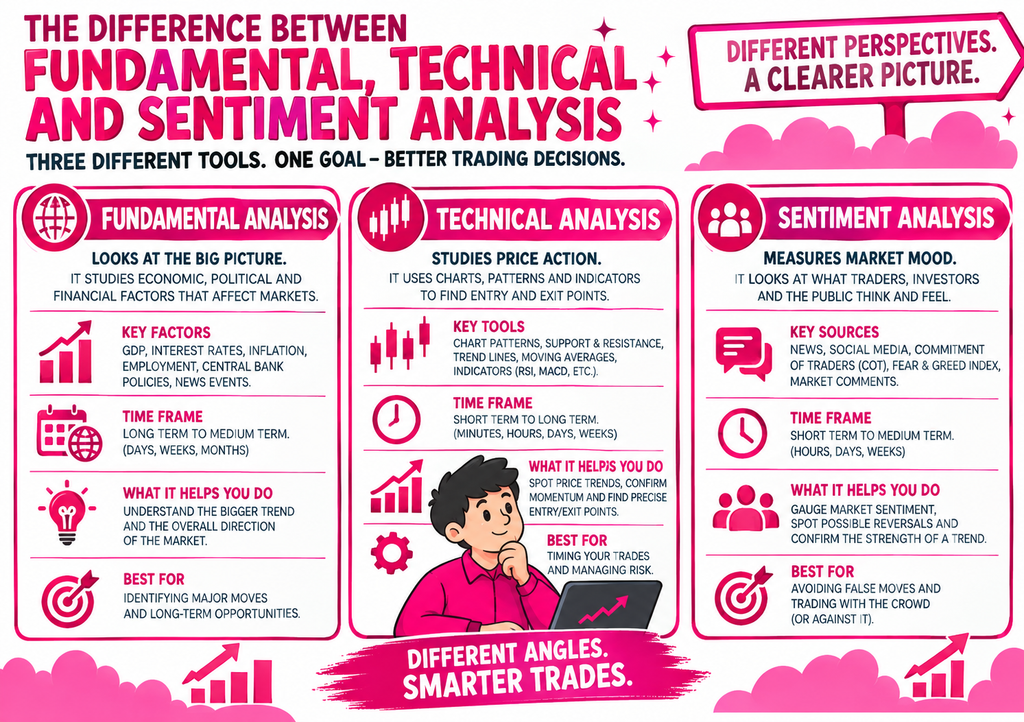
Fundamental Analysis — “Why Is the Market Moving?”
Fundamental analysis focuses on the economic and financial factors that influence an asset’s value.
For forex, traders may watch:
- Interest rates
- Inflation
- Employment data
- GDP growth
- Central bank decisions
- Economic news
For gold, traders may pay attention to:
- U.S. interest rates
- Inflation
- The U.S. dollar
- Central bank demand
- Geopolitical developments
Example :
Imagine you own a small shop.
You hear that the price of your supplier’s products is about to increase significantly. You would probably expect your costs to rise and might adjust your selling price.
A fundamental trader thinks in a similar way.
For example, if traders expect a central bank to cut interest rates, they may reassess currencies, bonds, gold and other assets based on how lower rates could affect them.
Fundamental analysis asks:
“What is happening in the economy that could move this market?”
Technical Analysis — “What Is the Chart Telling Me?”
Technical analysis focuses primarily on price action and market data.
Instead of asking why the economy is changing, technical traders study what the market is actually doing.
They commonly use:
- Support and resistance
- Trendlines
- Candlestick patterns
- Moving averages
- RSI
- MACD
- Breakouts
- Chart patterns
Example :
Imagine you are watching a football match.
You don’t necessarily need to know every reason why a team is playing well. You can simply observe the score, possession, attacks and momentum to understand what is happening.
Technical traders do something similar with price.
Suppose gold repeatedly struggles to break $4,400. A technical trader may identify that level as resistance.
If price eventually breaks above it and holds, the trader may interpret that as a potential bullish signal.
Technical analysis asks:
“What is price doing, and what could it potentially do next?”
Sentiment Analysis — “What Are Traders Feeling?”
Sentiment analysis focuses on the overall mood and positioning of market participants.
Are traders optimistic? Are they fearful?
Are they aggressively buying?
Are they rushing to sell?
Markets are driven by people and institutions and emotions such as fear, greed, optimism and panic can influence price movements.
Traders may examine:
- Market positioning
- Commitment of Traders data
- Investor surveys
- Volatility
- Risk-on/risk-off behavior
- News and social-media reactions
Example :
Imagine a new restaurant opens in your neighborhood.
At first, only a few people visit.
Then everyone starts talking about it. The restaurant becomes crowded and suddenly people who weren’t interested before want to try it.
That’s sentiment.
In financial markets, when traders become extremely optimistic about an asset, buying pressure can increase. When fear spreads, selling pressure can accelerate.
Sentiment analysis asks:
“What are market participants thinking and feeling right now?”
So, Which One Is Better?
Rather than treating them as competitors, think of the three as different pieces of the same puzzle.
Fundamental = The Story
It helps you understand why the market could move.
Technical = The Map
It helps you identify where price is and potential levels or setups.
Sentiment = The Crowd
It helps you understand how traders are positioned and feeling.
Imagine gold is trading near a major resistance level.
Fundamental analysis:
Economic data suggests conditions that could support gold.
Technical analysis:
Gold is approaching resistance and forming a bullish chart pattern.
Sentiment analysis:
Market positioning shows strong optimism toward gold.
Now you have three different perspectives pointing toward the same market environment.
The Trader’s Three-Lens Approach
A powerful way to think about the market is:
Fundamentals:
What’s happening behind the market?
Technicals:
What is price showing me?
Sentiment:
What are traders feeling and doing?
When these three perspectives are understood together, you can develop a much clearer picture of the market.
But remember: analysis is about probabilities not guarantees.
No indicator, economic report or sentiment measure can predict every market move.
The goal isn’t to predict the future perfectly.
The goal is to understand the market, identify opportunities, manage risk and stay disciplined.
Final Thought
Think of trading like driving.
Fundamental analysis tells you why you’re taking the journey.
Technical analysis shows you the road and potential turns.
Sentiment analysis tells you how the other drivers are behaving.
A smart trader doesn’t rely on just one.
Learn to read the story, the chart and the crowd.