Your Biggest Trading Enemy Is Not the Market, It’s Your Mind

The market doesn’t have to defeat you. Sometimes, your own emotions do the job.
Imagine this…
It’s Monday morning. Kwame, an enthusiastic forex trader, wakes up early, grabs his phone and opens MetaTrader 5. He checks EUR/USD and notices a strong bullish movement. Excited by the opportunity, he quickly opens a buy position.
Within minutes, the trade moves into profit. He’s up $30, then $50. He’s smiling already, imagining how much more he could make.
But suddenly, the market pulls back.
His $50 profit drops to $20.
Instead of following his trading plan, Kwame panics and closes the position. A few minutes later, the market moves strongly in his original direction.
He watches helplessly as the opportunity he predicted plays out without him.
Frustrated, he tells himself, “I should have held that trade!”
Determined to recover the missed profit, he immediately enters another position without proper analysis. Unfortunately, this one goes against him.
He loses $40.
Now he’s angry. He increases his lot size, hoping to recover everything in one trade. Before he knows it, a small losing day has turned into a disastrous trading session.
Interestingly, the market did nothing unusual.
It moved up, pulled back and continued moving. That’s what markets do.
So, what really went wrong?
It wasn’t the market. It was Kwame’s mind.
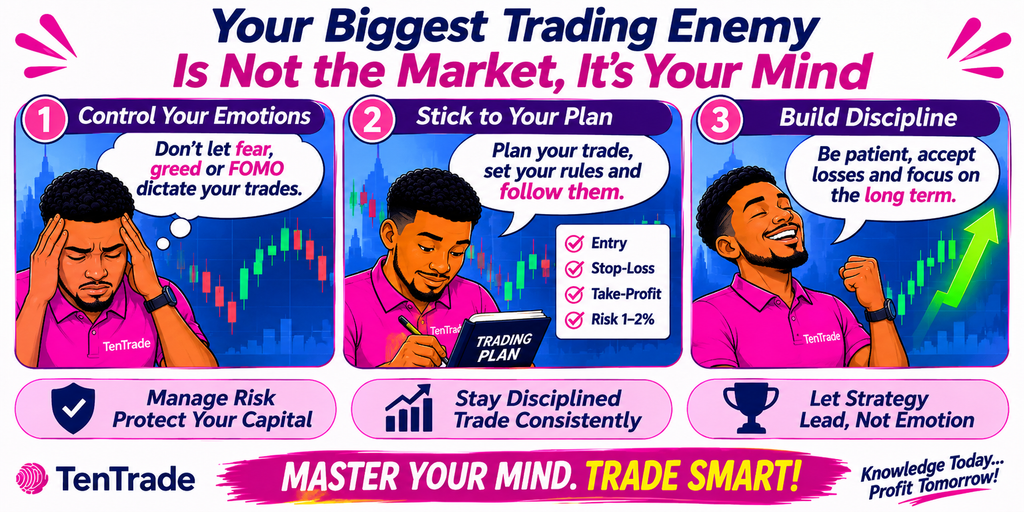
The Real Battle Happens Between Your Ears
Many traders spend hours learning technical analysis, studying candlestick patterns, drawing trendlines and identifying support and resistance levels.
They know how to identify opportunities, but struggle to manage themselves when real money is on the line.
Why?
Because knowing what to do and actually doing it are two different things.
Trading brings out emotions we experience in everyday life.
- Fear: You close a good trade too early because you’re afraid of losing your profit.
- Greed: You refuse to take profit because you believe the market will keep moving in your favour.
- FOMO: You enter a trade late because everyone in your trading group is celebrating a market move.
- Revenge: You increase your lot size after a loss because you desperately want your money back.
- Overconfidence: After three winning trades, you begin to feel like you cannot lose.
These emotions can turn a good trading strategy into a bad trading experience.
Five Everyday Trading Situations That Reveal Your Psychology
1. The Fear of Missing Out (FOMO)
You’ve been watching Gold all morning. Suddenly, XAU/USD makes a massive bullish move.
You weren’t in the trade, but your Telegram group is filled with messages like:
“Gold is flying! 🚀”
You quickly jump in, hoping to catch the remaining move.
Unfortunately, you enter just before the market reverses.
The lesson: Not every market movement is your opportunity. Missing a trade is not losing money. Sometimes, the best trade is the one you never take.
2. Revenge Trading: When Your Ego Takes Over
Imagine losing $20 on a trade.
Instead of accepting the loss, you immediately open another position with double the lot size.
Your thinking is simple: “I must recover my money before the day ends.”
But the market doesn’t know you lost money, and it certainly doesn’t owe you a winning trade.
You end up taking unnecessary risks and potentially turning a small loss into a much bigger one.
The lesson: A losing trade is part of trading. Never allow frustration to make your next trading decision.
3. Greed: When Enough Is Never Enough
You enter a trade with a $50 profit target.
The trade reaches $50, but you decide to hold longer because you want $100.
It reaches $70, then drops to $15.
Now you’re disappointed because you had an opportunity to secure your planned profit.
The lesson: Have a trading plan and respect it. There is nothing wrong with wanting more, but greed can make you lose sight of what you originally planned.
4. Fear of Taking Losses
Your trade is moving against you.
Your stop-loss is approaching, but instead of accepting the loss, you move it further away.
You convince yourself that the market will eventually reverse.
A small planned loss becomes a much larger one.
The lesson: Accepting a small loss is not failure. Protecting your trading capital is more important than proving that your analysis was right.
5. Overconfidence After Winning
You’ve had four consecutive winning trades.
Suddenly, you feel unstoppable. You increase your lot size, ignore your usual confirmation signals and start taking trades you would normally avoid.
Then comes one unexpected losing trade that wipes out a significant portion of your profits.
The lesson: Winning should build confidence, not carelessness. Discipline must remain consistent whether you’re winning or losing.
How Can You Win the Battle Against Your Mind?
Becoming a disciplined trader doesn’t mean eliminating emotions completely. It means learning not to let emotions control your decisions.
Here are five practical habits to develop:
- Create a trading plan: Know your entry, stop-loss, take-profit and risk before entering a trade.
- Follow the 1–2% risk rule: Avoid exposing too much of your trading capital to a single position.
- Accept losing trades: Understand that losses are part of the trading business.
- Take breaks: After a frustrating trading session, step away instead of forcing another opportunity.
- Keep a trading journal: Record your trades, decisions, emotions and mistakes to identify patterns in your behaviour.
The Final Lesson: Master Yourself Before Trying to Master the Market
Let’s return to Kwame.
A few weeks later, he decides to change his approach.
He stops chasing every market movement. He follows his trading plan, respects his stop-loss, controls his position sizes and learns to walk away after a difficult session.
He still experiences losing trades, but something changes.
He no longer allows one loss to determine his next decision. He understands that he doesn’t need to trade every day, catch every move or win every position to become a better trader.
His biggest improvement isn’t a new indicator or a better trading strategy.
It’s his mindset.
Remember: The market will always move in ways you cannot control. But how you respond to those movements is entirely your responsibility.
You can spend years trying to predict the market, but if you cannot manage your emotions, even the best strategy can fail.
The greatest trading skill isn’t just knowing when to buy or sell.
It’s knowing when to control yourself.