Position Sizing in Trading: The Secret to Managing Risk and Staying in the Game

Imagine having a trading account with $1,000. You spot what looks like a perfect buying opportunity on gold and everything on your chart suggests the price could move higher. You feel confident, so you decide to open a large trade because you want to make a significant profit.
Unfortunately, the market moves against you and within minutes, you lose $200.
Now imagine another trader with the same $1,000 account who spots the same opportunity but carefully calculates how much to risk before entering the market. When the trade goes against them, they lose only $10.
Both traders analysed the same market and entered the same trade but their results were completely different. What made the difference? Position sizing.
Position sizing, also known as lot sizing, is one of the most important skills every trader must understand. It helps determine how much of a financial instrument to buy or sell when opening a trade. More importantly, it helps control how much money you stand to lose if the market moves against your prediction.
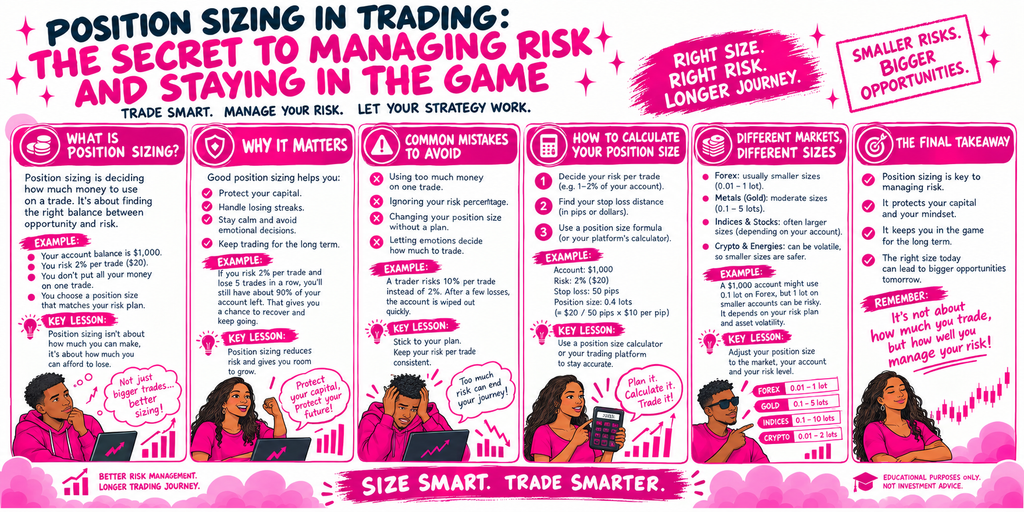
What Exactly Is Position Sizing?
Position sizing is the process of calculating the appropriate trade volume based on your account balance, risk tolerance and stop-loss distance.
In forex trading, trade volume is commonly measured in lots.
For example:
- Standard lot: 100,000 units of the base currency.
- Mini lot: 10,000 units.
- Micro lot: 1,000 units.
- Nano lot: 100 units.
Think of lot sizing like choosing how much food to buy at the market. If you are cooking for two people, buying food meant for twenty people may be unnecessary and wasteful. Similarly, if you have a small trading account, opening an excessively large position can expose you to unnecessary financial risk.
The goal is not simply to open bigger trades to make bigger profits. It is to choose a trade size that your account can comfortably accommodate.
Why Is Position Sizing So Important?
Many traders spend hours studying candlestick patterns, support and resistance, indicators and market trends. However, they sometimes overlook the importance of calculating their trade volume.
Even a good trading strategy can produce poor results when position sizing is ignored.
Here are three reasons why it matters:
A. It protects your trading capital
Your capital is your most important resource as a trader. If you risk too much on a single trade, a few consecutive losses could significantly reduce your account balance.
For example, imagine you have $500 and decide to risk 20% on every trade. After just three consecutive losses, your account would fall to approximately $256.
However, risking 2% per trade would leave you with approximately $470 after three consecutive losses.
The difference is significant!
B. It helps control emotions
Have you ever opened a trade and spent the entire day checking your phone because you were afraid of losing money?
Sometimes, that anxiety comes from taking a position that is too large for your account.
When your position size is appropriate, you are more likely to remain calm, follow your trading plan and make decisions based on analysis rather than fear.
C. It promotes consistency
Professional trading is not about making huge profits from one trade. It is about following a repeatable process that allows you to manage risk over time.
Position sizing helps you maintain a consistent percentage of risk, regardless of the instrument you trade or the trading opportunity you identify.
How Do You Calculate the Correct Lot Size?
Let’s make this practical.
Imagine you have a trading account of $1,000 and decide that you are comfortable risking 2% on a single trade.
Your maximum risk would be:
$1,000 times 2% = $20
This means that if your stop loss is triggered, your planned loss should be approximately $20, excluding additional trading costs.
Now, suppose you identify a buying opportunity on EURUSD with a stop-loss distance of 20 pips.
For a standard EURUSD account denominated in USD, one standard lot is approximately worth $10 per pip.
The calculation becomes:
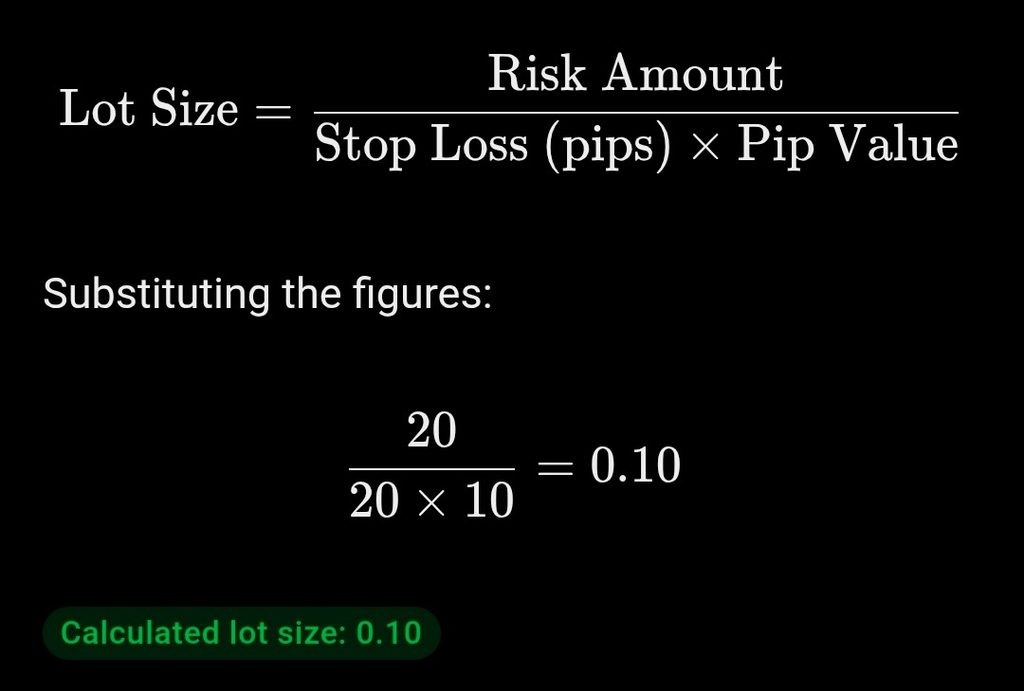
This means you would open a 0.10-lot position to risk approximately $20 if your stop loss is reached.
Remember, pip values differ across instruments and account currencies. For gold, indices, cryptocurrencies and other CFDs, use the contract specifications provided by your broker.
The Relationship Between Stop Loss and Lot Size
Here is something many beginners overlook: Your stop-loss distance directly influences your position size.
Let’s use the same $1,000 account and 2% risk, giving you a maximum risk of $20.
Consider these three trading scenarios on EURUSD:
| Stop-loss distance | Lot size | Planned risk |
| 10 pips | 0.20 | $20 |
| 20 pips | 0.10 | $20 |
| 40 pips | 0.05 | $20 |
Notice something interesting?
The wider your stop loss, the smaller your position size needs to be to maintain the same financial risk.
This is why you should never randomly choose your lot size before determining where your stop loss belongs.
Your stop loss should be based on market structure and your trading strategy. Your position size should then be calculated around it.
Common Position Sizing Mistakes Traders Make
Even experienced traders sometimes make mistakes when determining their trade volume. Here are some common ones to avoid:
1. Trading with emotions
You make a profit today and suddenly feel confident enough to double your lot size tomorrow. Unfortunately, confidence is not a risk management strategy.
2. Using the same lot size on every trade
A 20-pip stop loss and a 100-pip stop loss do not carry the same financial risk when using the same lot size. Adjust your volume according to your stop-loss distance.
3. Increasing lot size to recover losses
After losing $50, you decide to open a much larger position to recover the money quickly. This is often how a small loss becomes a devastating one.
4. Ignoring leverage
High leverage allows you to control larger positions with relatively little margin. However, it does not reduce the actual financial risk of your trade. A larger position can still produce significant losses.
5. Forgetting about multiple open trades
Opening five trades with 2% risk each could expose your account to 10% potential risk if all their stop losses are triggered. Always consider your total exposure, especially when trading correlated instruments.
Practical Example: Two Traders, One Market
Let’s imagine two traders who both have $1,000 accounts and identify the same buying opportunity on gold.
- Trader A opens a 1.00-lot position without properly calculating the risk.
- Trader B calculates the position size based on a 2% risk limit.
The market suddenly moves against both traders.
Trader A experiences a significant loss because of the oversized position, while Trader B experiences a much smaller, controlled loss.
Interestingly, both traders could have made the same profit if the market had moved in their favour. However, the difference is that Trader B has protected more of their capital when the analysis fails.
This is an important lesson:
You do not have to predict every market movement correctly to become a disciplined trader. You need to know how much you are willing to lose when you are wrong.
Develop a Position Sizing Routine
Before entering your next trade, make it a habit to answer these questions:
- What is my current account balance?
- How much am I willing to risk on this trade?
- Where should my stop loss be based on market structure?
- How many pips or points separate my entry from my stop loss?
- What lot size will keep my potential loss within my risk limit?
- How much total risk am I already carrying across other open positions?
These simple questions can help you avoid unnecessary exposure and improve your trading discipline.
Final Thoughts: Bigger Lots Do Not Always Mean Better Trading
One of the biggest misconceptions in trading is that successful traders are those who consistently open large positions and make huge profits.
In reality, successful trading requires a combination of market understanding, patience, emotional discipline and effective risk management.
Position sizing helps you stay in control of your trades, protect your capital and survive periods when the market does not move in your favour.
Remember, the objective is not to make the most money from one trade. It is to build a trading approach that allows you to participate in the market without putting your entire account at unnecessary risk.
Your analysis determines where you want to trade, your stop loss determines where your idea is invalidated, but your position size determines how much you stand to lose when you are wrong.
Trade smart, calculate your lot size and always apply proper risk management.