From FOMO to FOGO: Are You Trading for Profit or Out of Fear?

The fascinating story of Kofi, a trader who discovered that his biggest enemy wasn’t the market, but his own emotions.
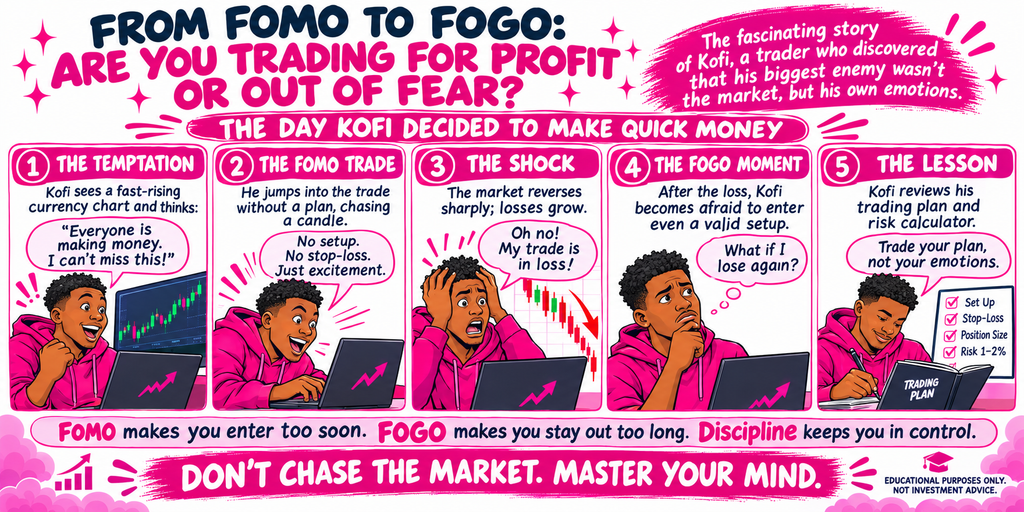
The Day Kofi Decided to Make Quick Money
Kofi was an ambitious young trader who had been trading Forex for almost a year. Like many traders, he dreamed of financial freedom. He spent hours studying charts, watching YouTube tutorials and following market analysts.
One Monday morning, Kofi opened his trading platform and noticed that Gold (XAUUSD) was moving aggressively upwards.
He immediately checked his WhatsApp trading group. Some members were already celebrating their profits.
One trader posted: “Gold just gave me 80 pips! What a beautiful move!”
Another shared a screenshot showing a $350 profit.
Kofi looked at his screen and became uncomfortable.
“Ei! How did I miss this opportunity?” he exclaimed.
He had actually been monitoring Gold earlier, but his trading conditions were not yet complete. Instead of waiting, he convinced himself that the market was about to move even higher.
Without proper confirmation, he opened a BUY position.
Initially, the trade moved in his favour. Kofi became excited and started imagining how much money he would make.
But suddenly, Gold reversed.
His floating profit disappeared, and his account moved into a loss.
He panicked, closed the trade and watched the market recover shortly afterwards.
That morning, Kofi experienced something many traders struggle with: FOMO (Fear of Missing Out).
When the Fear of Missing Out Takes Control
FOMO is the feeling that everyone else is making money while you are missing out on profitable opportunities.
It makes you believe that every market movement is an opportunity you must participate in.
For Kofi, it started with a simple WhatsApp notification. Seeing other traders celebrate their profits made him feel that he was falling behind.
He forgot his trading plan and started chasing the market.
Over the next few days, the situation became worse.
Whenever EURUSD moved, he wanted to enter. When Bitcoin rallied, he wanted to buy. When Gold dropped, he rushed to sell.
He was no longer waiting for his setups. He was reacting to every movement.
His account began suffering because he was taking trades without proper analysis, confirmation or risk management.
Eventually, Kofi realised something important:
The market does not owe you an opportunity every day. Missing a trade is better than entering a bad one.
The Unexpected Visitor: FOGO
After several unnecessary losses, Kofi decided to take a break and review his trading behaviour.
He reduced his lot sizes, studied his mistakes and promised himself never to chase the market again.
However, something unexpected happened.
The following week, Kofi identified a beautiful EURUSD BUY setup. His analysis showed a bullish trend, price had pulled back to a support area, and a bullish confirmation candle had appeared.
Everything was according to his trading strategy.
But just before entering, he remembered his recent losses.
“What if this trade also goes against me?”
He hesitated.
He waited for another candle. Then another. Eventually, the market started moving upwards without him.
Kofi watched as the opportunity disappeared.
This time, he wasn’t chasing the market. He was avoiding it.
Welcome to FOGO: Fear of Going On.
FOGO describes the fear of continuing to trade because of uncertainty, previous losses or anxiety about losing money again.
While FOMO makes you enter trades you shouldn’t take, FOGO can make you avoid valid opportunities that meet your trading conditions.
Kofi had moved from one emotional extreme to another.
First, he was afraid of missing opportunities. Now, he was afraid of participating in them.
The Turning Point: A Conversation That Changed Everything
One evening, Kofi met an experienced trader called Daniel at a local café.
After listening to Kofi explain his struggles, Daniel smiled and asked him a simple question:
“Kofi, when you enter a trade, are you following your strategy or trying to prove something to the market?”
Kofi couldn’t answer immediately.
Daniel continued:
“Imagine you are driving from Accra to Kumasi. Would you drive through every road you see just because other drivers are using them? Of course not! You have a destination, and you follow the right route to get there.”
He explained that trading works in a similar way.
You don’t need to participate in every market movement. You need to identify opportunities that align with your strategy.
Daniel gave Kofi three important lessons:
1. Stop Comparing Your Results With Other Traders
Someone else’s $500 profit doesn’t mean you must make $500 today. Every trader has a different account size, strategy, experience and risk tolerance.
2. Accept That Losses Are Part of Trading
Even the best trading strategies experience losing trades. What matters is whether you manage your risk and remain consistent with your approach.
3. Learn When to Enter and When to Stay Out
Don’t enter because the market is moving, and don’t avoid a valid setup simply because you are afraid of losing.
Kofi finally understood that successful trading wasn’t about predicting every market movement. It was about controlling his decisions.
The 30-Day Challenge: Kofi Changes His Trading Habits
Determined to improve, Kofi introduced a few rules into his trading routine.
- He would risk only 1% of his trading capital per trade.
- He would wait for confirmation before entering a position.
- He would stop chasing candles that had already made significant moves.
- He would avoid revenge trading after losses.
- He would maintain a trading journal and record his emotions.
- He would accept that some days offered no suitable trading opportunities.
A few weeks later, Kofi noticed a significant difference.
He was no longer checking his phone every minute to see what other traders were making.
He stopped entering random positions because someone had posted a profitable trade.
More importantly, he became comfortable with waiting.
One Friday morning, Gold started moving aggressively again. His WhatsApp group was buzzing with trading signals and profit screenshots.
Kofi looked at his chart.
His trading conditions were not complete.
He smiled, closed the platform and went about his day.
For the first time, he didn’t feel that he was missing out.
He understood that protecting his capital was also part of trading.
The Biggest Lesson: Are You Trading for Profit or Out of Fear?
Kofi’s journey teaches us that FOMO and FOGO are two sides of the same psychological problem: allowing emotions to control trading decisions.
Think about it:
- Have you ever entered a trade simply because you saw someone else making money?
- Have you ever increased your lot size because you wanted to recover a previous loss?
- Have you ever closed a profitable position too early because you were afraid of losing the profit?
- Have you ever ignored a valid trading opportunity because of previous losses?
- Have you ever taken multiple trades simply because you felt you weren’t making enough money?
If you answered yes to any of these questions, you may be allowing emotions to influence your trading decisions.
The solution is not to become emotionless. It is to develop the discipline to recognise your emotions without allowing them to dictate your actions.
Final Thoughts: Become the Trader Who Controls the Fear
Kofi eventually discovered that the biggest battle in trading wasn’t between buyers and sellers. It was between his trading strategy and his emotions.
The market will always move. Gold will rise and fall, currencies will fluctuate, and cryptocurrencies will experience rallies and corrections.
There will always be another opportunity.
But your trading capital may not survive if you continue allowing fear, greed and impatience to control your decisions.
Remember:
FOMO makes you chase opportunities. FOGO makes you run away from them. Discipline teaches you when to act and when to wait.
The next time you open your trading platform, ask yourself:
Am I trading because my strategy says so, or because my emotions are pushing me to act?
Because at the end of the day, the goal isn’t to catch every market movement. The goal is to become a disciplined trader who can survive, learn and grow consistently.
Trade the plan, not the panic.