How Your Beliefs Affect Your Trading: The Mindset Behind Every Trade

Have you ever closed a trade too early because you were afraid of losing your profit, only to watch the market move in your expected direction? Or entered a trade without proper analysis simply because you believed the price could only go higher?
If this sounds familiar, you are not alone. Many traders spend hours studying charts, learning indicators and following economic news, yet overlook one of the most powerful forces influencing their decisions: their beliefs.
The truth is that your trading results are influenced not only by what you know about the market but also by what you believe about yourself, money, risk and success.
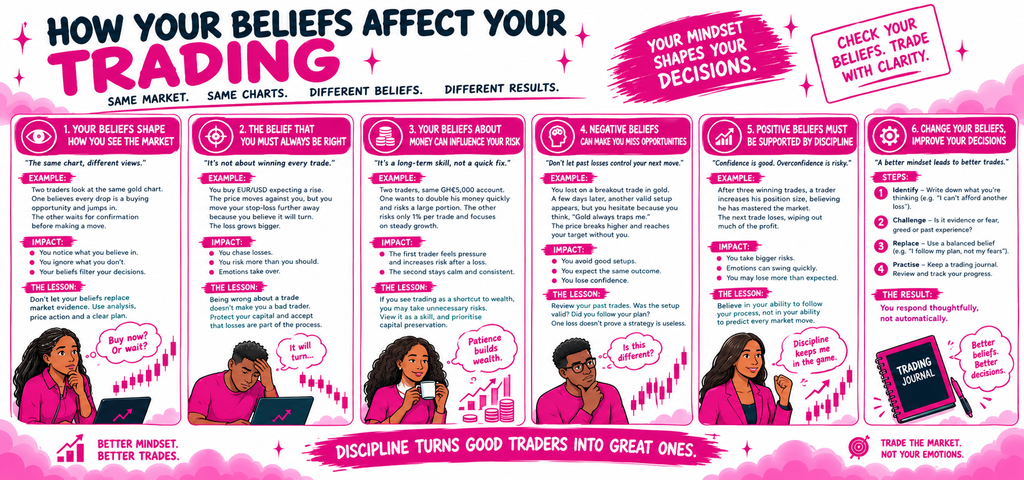
1. Your Beliefs Shape How You See the Market
Imagine two traders looking at the same gold chart. Both see the price falling toward a support level.
The first trader believes that every market drop is an opportunity to buy. He immediately enters a buy trade without waiting for confirmation.
The second trader believes that price movements require evidence, not assumptions. She waits to see whether buyers actually defend the support level before making a decision.
They are looking at the same chart, but their beliefs influence how they interpret the information.
This happens because beliefs act like filters. They influence what you notice, what you ignore, and how you respond to uncertainty.
The lesson: Do not allow your beliefs to replace market evidence. Build your decisions around price action, analysis and a clear trading plan.
2. The Belief That You Must Always Be Right
One of the most dangerous beliefs in trading is the idea that a good trader should win every trade.
Imagine you buy EUR/USD, expecting the price to rise. Instead, the market moves against you, and your stop-loss is approaching.
Rather than accepting the loss, you move your stop-loss further away because you believe the market must eventually turn in your favour.
The price continues falling and a small, manageable loss becomes a much bigger problem.
Why did this happen? You were more focused on proving yourself right than protecting your trading capital.
Successful trading is not about winning every trade. It is about making decisions with a potential advantage, managing risk, and accepting that losses are part of the process.
Remember: Being wrong about a trade does not make you a bad trader. Refusing to accept when you are wrong can make the situation worse.
3. Your Beliefs About Money Can Influence Your Risk
Consider two traders with the same $5,000 trading account.
Trader A believes that trading is a way to become rich quickly. He risks a large portion of his capital on one gold trade because he wants to double his money within a week.
Trader B believes that trading is a skill that requires patience and discipline. She risks only 1% of her account on each trade, which is $50 and understands that growth takes time.
Although both traders have the same starting capital, their beliefs lead to very different decisions.
Trader A may experience emotional pressure after a loss and increase his risk to recover quickly. Trader B has a clearer risk limit and can approach the next trade more calmly.
Of course, a 1% risk does not guarantee profits, but it helps limit the damage caused by an individual losing trade.
The lesson: If you believe trading is a shortcut to wealth, you may take unnecessary risks. If you view it as a long-term skill, you are more likely to prioritise capital preservation and consistency.
4. Negative Beliefs Can Make You Miss Opportunities
Have you ever avoided a trade because you lost money on a similar setup in the past?
Suppose you previously bought gold after a breakout, only for the price to reverse and hit your stop-loss. A few days later, another valid breakout appears.
This time, you hesitate. You tell yourself, “Gold always traps me during breakouts.”
The price breaks higher and reaches your planned target without you.
Your previous loss has now influenced a new decision, even though the current setup may be completely different.
This is how negative experiences can turn into limiting beliefs. Instead of evaluating each opportunity objectively, you begin to expect the same outcome every time.
However, the solution is not to ignore past losses. It is to review them properly.
Ask yourself:
- Did I follow my trading plan?
- Was the setup valid?
- Did I enter too early?
- Was the loss part of normal market uncertainty?
A single loss does not prove that a strategy is useless. Equally, one winning trade does not prove that a strategy works. You need evidence from a meaningful sample of trades.
5. Positive Beliefs Must Be Supported by Discipline
Confidence is important in trading, but confidence without discipline can become overconfidence.
Imagine a trader who makes three consecutive profitable trades. He begins to believe that he has mastered the market and increases his position size significantly.
Unfortunately, the next trade loses, wiping out much of the profit from the previous three trades.
His mistake was not believing in himself. It was believing that recent success made him almost immune to risk.
A healthier belief would be: “I can improve my trading through preparation, consistent execution, and learning from my results, but every trade carries risk.”
This type of confidence encourages patience without creating unrealistic expectations.
Believe in your ability to follow your process, not in your ability to predict every market move.
6. How to Identify and Change Limiting Trading Beliefs
Changing your trading mindset starts with recognising the thoughts that influence your decisions.
Here are four practical steps you can apply.
Step 1: Identify the belief.
After a difficult trade, write down what you were thinking. For example: “I cannot afford another loss,” or “If I close now, the market will reverse immediately.”
Step 2: Challenge the belief.
Ask yourself whether the thought is supported by evidence or driven by fear, greed or a previous experience.
Step 3: Replace it with a more balanced belief.
Instead of saying, “I must recover today’s loss,” tell yourself, “My job is to follow my plan. I do not need to trade to recover money immediately.”
Step 4: Practise the new belief.
Use a trading journal to record your decisions, emotions, risk levels, and results. Review your performance regularly to see whether your behaviour is improving.
Over time, this process can help you respond more thoughtfully instead of reacting automatically.
Final Thoughts: Change Your Thinking, Improve Your Decisions
The financial markets do not reward you simply because you believe strongly in a particular outcome. Price can move against your expectations regardless of how confident you feel.
What matters is how your beliefs influence your actions when the market becomes uncertain.
If you believe you must always win, you may struggle to accept losses. If you believe you must get rich quickly, you may take excessive risks. But if you believe that trading is a continuous learning process, you can focus on discipline, risk management, and gradual improvement.
The next time you prepare to enter a trade, do not just ask, “What is the market likely to do?”
Also ask yourself, “What do I believe right now and is that belief helping me make a better decision?”
Because sometimes, the biggest change your trading needs is not a new indicator or strategy. It is a better understanding of the mind behind the trade.