The US Dollar vs Gold: Understanding the Relationship and Finding Trading Opportunities in Volatile Markets

Imagine you are a trader sitting in front of your computer on a Monday morning. You open your trading platform and notice something interesting: the US Dollar is gaining strength, but Gold is also climbing.
You pause and ask yourself: Aren’t Gold and the US Dollar supposed to move in opposite directions?
You decide to wait, but within minutes, Gold moves another $20 higher. Suddenly, you realise that understanding the relationship between these two powerful financial instruments could make a significant difference in your trading decisions.
Welcome to one of the most interesting relationships in the financial markets: The US Dollar versus Gold.
For traders, understanding how these two assets interact is more than just financial knowledge. It is a valuable tool for identifying opportunities, understanding market sentiment and making better trading decisions, especially when volatility increases.
1. Why Does Gold Often Move Opposite to the US Dollar?
To understand this relationship, let’s use a simple example.
Imagine you live in Ghana and want to purchase a product priced in US dollars. When the dollar becomes stronger against the Ghanaian cedi, you need more cedis to purchase the same amount of dollars.
Something similar happens in the international Gold market.
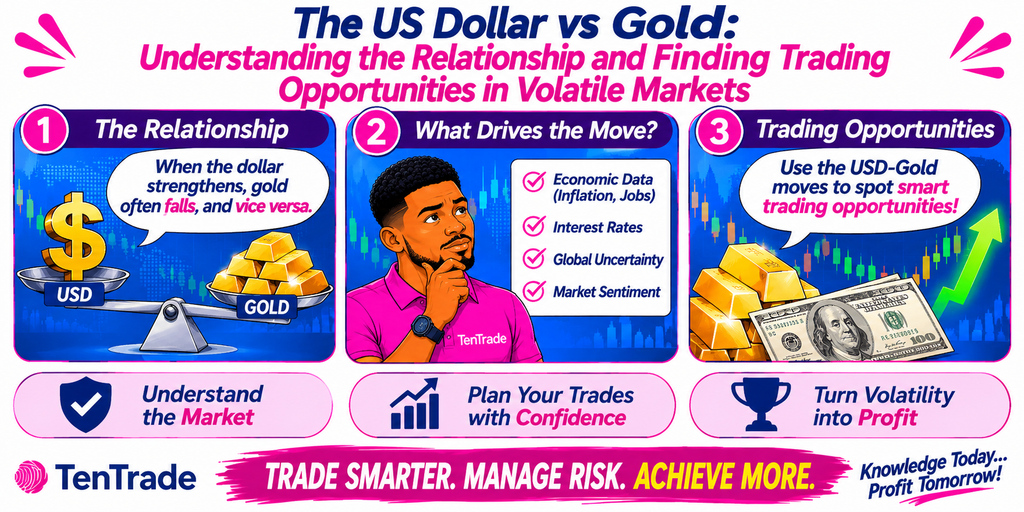
Gold is primarily priced in US dollars. When the dollar strengthens, Gold becomes more expensive for buyers using other currencies. This can reduce international demand and put downward pressure on Gold prices.
On the other hand, when the dollar weakens, Gold becomes relatively cheaper for international buyers, potentially increasing demand and supporting higher prices.
This explains why Gold and the US Dollar Index (DXY) often move in opposite directions.
However, remember something important: Their relationship is not always perfect. Gold can rise alongside the dollar when investors are seeking safety, central banks are increasing Gold purchases, or other market forces are driving demand.
Understanding this exception is just as important as understanding the general relationship.
2. The Interest Rate Connection: Why the Federal Reserve Matters
Now, let’s introduce another important character into our story: the US Federal Reserve.
Imagine the Federal Reserve announces that inflation remains high and interest rates may need to stay elevated for longer.
What happens next?
Investors may begin moving their money towards US dollar-denominated assets because higher interest rates can make US investments more attractive.
As demand for the dollar increases, the DXY may strengthen.
At the same time, Gold could experience selling pressure because Gold does not pay interest or dividends. When interest-bearing investments offer more attractive returns, the opportunity cost of holding Gold increases.
But the opposite can also happen.
If the Federal Reserve signals possible interest rate cuts, the dollar may weaken while Gold gains support as investors adjust their expectations.
The trading lesson: Don’t just watch Gold and the dollar. Pay attention to Federal Reserve decisions, inflation reports, employment figures and US Treasury yields. These factors can influence the direction of both markets.
3. A Real-Life Trading Scenario: When the Dollar Strengthens
Let’s imagine a trader named Kofi.
Kofi has been monitoring XAU/USD on the 4-hour timeframe. He notices that Gold has been trading around $3,600, but recent US economic data comes in stronger than expected.
The market begins pricing in a more cautious Federal Reserve approach towards interest rate cuts.
The US Dollar Index starts climbing, while Gold struggles to break above resistance.
Instead of immediately opening a sell position, Kofi takes three important steps:
- Checks the DXY: He observes that the dollar is breaking above a previous resistance level, suggesting increasing bullish momentum.
- Studies Gold: He notices that XAU/USD is forming lower highs and trading below a descending trendline.
- Waits for confirmation: Gold breaks below support, retests the broken level and struggles to move higher.
Kofi identifies a potential selling opportunity.
He enters a SELL position after bearish confirmation, places his stop-loss above the recent swing high and targets the next major support level.
Rather than predicting the market, he waits for the market to show him its direction.
This is how understanding the dollar-Gold relationship can help traders build a stronger trading strategy.
4. Finding Opportunities When Both Gold and the Dollar Rise
Here is where things become even more interesting.
Imagine another trading session where geopolitical tensions increase, global investors become nervous and financial markets experience significant uncertainty.
Investors begin purchasing US dollars because of their liquidity and purchasing Gold because of its traditional safe-haven appeal.
As a result, both assets rise.
Does this mean the relationship has stopped working?
Not necessarily.
It simply means that other market forces are temporarily stronger than the traditional dollar-Gold relationship.
For example, during periods of geopolitical uncertainty, traders may seek protection in both assets. Central bank Gold purchases can also support Gold prices even when the dollar remains strong.
The trading lesson: Never enter a Gold trade simply because the dollar is rising or falling. Always examine the broader economic environment and confirm your setup using price action.
5. Five Ways to Find Trading Opportunities Using DXY and Gold
Understanding the relationship is one thing. Knowing how to apply it to your trading decisions is another.
Here are five practical ways to use the dollar-Gold relationship.
1. Monitor DXY for Directional Clues
The US Dollar Index measures the dollar against a basket of major currencies. When DXY shows strong bullish momentum, Gold may face downward pressure.
When DXY weakens, Gold may find room to move higher.
Use DXY as a supporting indicator, not a standalone trading signal.
2. Identify Important Support and Resistance Levels
Mark major support and resistance zones on XAU/USD. Observe whether the dollar is strengthening or weakening as Gold approaches these levels.
A bearish DXY move combined with Gold breaking above resistance could strengthen a bullish trading setup.
3. Watch US Economic News
Pay attention to important economic releases, including:
- US Consumer Price Index (CPI).
- Non-Farm Payrolls (NFP).
- Federal Reserve interest rate decisions.
- US Producer Price Index (PPI).
- US unemployment and employment data.
These events can trigger significant volatility in Gold and the dollar.
4. Follow Treasury Yields
US Treasury yields are another important factor to monitor. Rising real yields can increase the opportunity cost of holding Gold, while falling real yields can provide support.
However, yields, the dollar and Gold do not always move in predictable patterns.
5. Wait for Technical Confirmation
Use tools such as trendlines, candlestick patterns, moving averages and market structure to identify potential entry points.
For instance, if DXY is weakening and Gold breaks above resistance, wait for a successful retest before considering a BUY position.
The objective is to combine fundamental analysis with technical confirmation rather than relying on one indicator.
6. How to Trade Gold During High-Volatility Periods Without Losing Control
Volatility can create exciting opportunities, but it can also expose traders to significant losses.
Imagine Gold moves $30 within a few minutes following an unexpected US economic announcement. You see a strong bullish candle and quickly open a BUY position because you don’t want to miss the move.
Unfortunately, price reverses sharply, hits your stop-loss and leaves you frustrated.
The problem was not necessarily your market direction. It was the decision to enter without considering the risk.
Here are some important rules to follow:
- Risk only 1–2% of your trading capital per trade, or less where appropriate.
- Avoid entering immediately before major economic announcements unless your strategy is designed for news volatility.
- Use stop-loss orders based on market structure and position size.
- Avoid increasing lot sizes simply because the market is moving quickly.
- Maintain a sensible risk-to-reward ratio.
- Remember that spreads and slippage can increase during major news events.
A good trading opportunity is not worth risking your entire account.
7. The Biggest Mistake Traders Make When Analysing Gold and the Dollar
One of the most common mistakes traders make is assuming that Gold must fall whenever the dollar rises.
This is not always true.
Consider three different situations:
- Situation One: The dollar strengthens because US interest rates are expected to remain high. Gold may face selling pressure.
- Situation Two: Global uncertainty increases. Both Gold and the dollar may rise as investors seek safety.
- Situation Three: The dollar weakens while inflation concerns increase. Gold may attract additional demand as investors seek protection against declining purchasing power.
The same market relationship can produce different outcomes depending on the underlying economic conditions.
That is why successful traders look beyond price movements and ask a more important question:
What is driving the market right now?
Conclusion: Trade the Relationship, Not the Assumption
The relationship between the US Dollar and Gold offers traders an interesting way to understand market behaviour and identify potential trading opportunities.
When the dollar strengthens, Gold may face downward pressure. When the dollar weakens, Gold may find support. But during periods of economic uncertainty, geopolitical tension and changing investor sentiment, both assets can move in the same direction.
The real advantage comes from combining fundamental analysis, technical analysis and disciplined risk management.
So, the next time you open your trading platform and notice the US Dollar gaining strength, don’t immediately rush to sell Gold. Take a step back, study the economic environment, analyse DXY, identify important price levels and wait for confirmation.
Remember, the market rewards preparation, not prediction.
Trade smart, manage your risk and let the charts tell the story.