The Golden Rules of Trading Risk Management

Trading is not just about finding the right entry. It is about staying in the game long enough for your good trades to matter. A trader can have a great strategy and still lose an account by taking too much risk.
Think of trading like driving a car. You may be an excellent driver, but without a seatbelt, brakes and speed limits, one mistake can cause serious damage. Risk management is the seatbelt of trading.
Here are the golden rules every trader should understand.
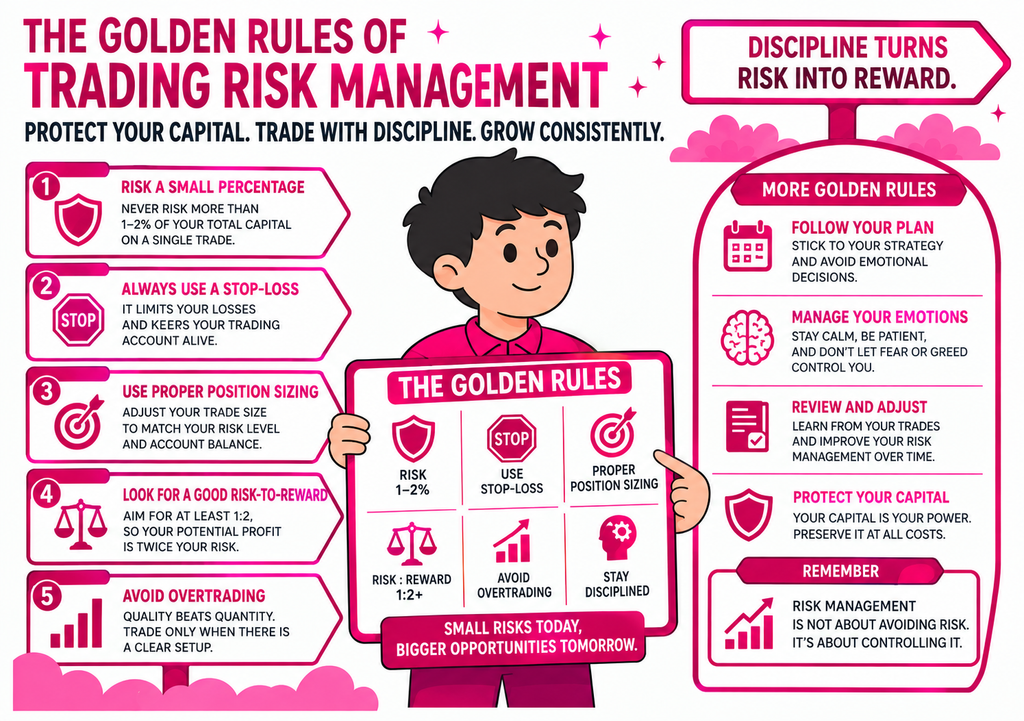
Never Risk Too Much on One Trade
Avoid putting a large portion of your account on a single idea.
For example, if you have a $1,000 account and risk 2% per trade, your maximum planned loss is $20. If the trade fails, you still have $980 to continue trading.
But if you risk 20% and lose, your account drops to $800 immediately. Recovering from large losses becomes much harder.
Golden rule: Protect your capital first. Profits come second.
Always Know Your Stop Loss
A stop loss is your emergency exit. Before entering a trade, know exactly where you will accept that your idea is wrong.
Imagine buying gold because you expect it to rise. Instead of saying, “I will close when it starts falling,” define the level where your analysis becomes invalid.
This removes emotion from the decision.
Plan the loss before you plan the profit.
Risk Based on Your Account, Not Your Emotions
After winning three trades, you may feel confident and want to increase your lot size. After losing two trades, you may want to trade bigger to recover quickly.
Both reactions can be dangerous.
Your position size should be based on your account size, stop-loss distance and chosen risk percentage, not whether you feel lucky, angry or confident.
Respect the Risk-to-Reward Ratio
A good trade should offer a reasonable potential reward compared with the amount you are risking.
For example, suppose you risk $20 to potentially make $40. Your risk-to-reward ratio is 1:2.
You do not need every trade to win. If your strategy is profitable over time, a few larger winners can compensate for some losing trades.
Think long term, not trade by trade.
Never Move Your Stop Loss Just to Avoid a Loss
One of the most common mistakes is moving a stop loss farther away after the market gets close to it.
A trader might think: “Let me give the trade a little more room.”
Then $20 of planned risk becomes $40, then $60.
That is no longer risk management, it is hoping the market changes direction.
If your original setup is invalidated, accept the loss and move on.
Avoid Revenge Trading
Imagine losing $50 in the morning. You become frustrated and decide to make $50 back immediately.
You take another trade without a proper setup and lose $70. Now you are down $120 and become even more emotional. This is revenge trading.
The market does not know or care that you lost money. Your next trade should be based on your strategy, not on your desire to recover yesterday’s loss.
A loss is part of trading. Chasing losses is a choice.
Do Not Overtrade
More trades do not automatically mean more profits.
If you have a $1,000 account and take 15 random trades in one day, even small losses can add up quickly. Instead, wait for setups that match your strategy.
Quality over quantity.
Understand Correlation
Sometimes traders think they are taking several independent trades when they are actually taking the same risk repeatedly.
For example, being heavily exposed to EURUSD, GBPUSD and XAUUSD at the same time may create significant exposure to movements in the U.S. dollar.
Before opening several positions, ask:
“Am I diversifying my trades, or simply repeating the same bet?”
Be Careful During Major News Events
Markets can move sharply during events such as interest-rate decisions, inflation reports and employment data.
Imagine risking $20 on a trade, but a major announcement causes gold to move rapidly through your planned level. Your actual loss may differ from the amount you expected because of volatility and execution conditions.
Always understand the event calendar and adjust your exposure when necessary.
Protect Your Trading Psychology
Risk management is also about protecting your mind. If a potential loss is so large that you cannot sleep, you are probably risking too much.
A trader who is comfortable with the possible loss is more likely to follow the trading plan calmly.
The best risk level is one you can emotionally handle.
The Trader’s Golden Checklist
Before entering any trade, ask yourself:
- How much am I risking?
- Where is my stop loss?
- Where is my target?
- What is my risk-to-reward ratio?
- Does this setup match my strategy?
- Am I overexposed to similar positions?
- Is major economic news approaching?
- Can I accept the potential loss without making emotional decisions?
If you cannot answer these questions, you may not be ready to enter the trade.
Final Thought
Successful trading is not about avoiding every loss. Losses are part of the business.
The real goal is to make sure that one bad trade, one emotional decision or one unexpected market move does not destroy your account.
Remember:
Protect your capital. Control your risk. Stay disciplined. Let your edge work over time.
Because in trading, survival comes before success.