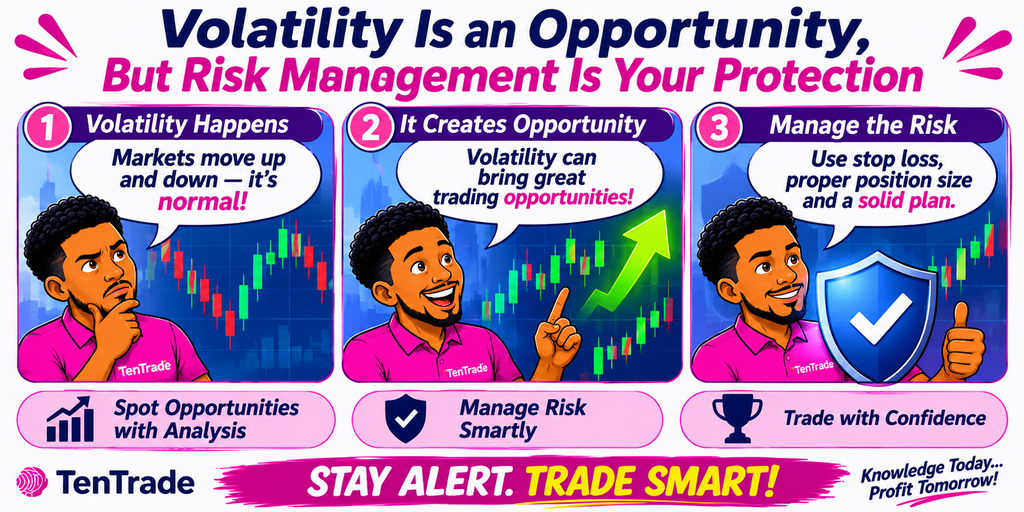
Volatility Is an Opportunity, But Risk Management Is Your Protection

Imagine driving on a busy New York road during rush hour. Cars are moving in every direction, some speeding, others changing lanes unexpectedly. There is an opportunity to get to your destination faster, but without careful driving, one wrong move could cause an accident.
Trading during high market volatility is very similar.
The market may move quickly, creating exciting opportunities to make profits. But without proper risk management, those same movements can wipe out your trading capital.
When Opportunity Turns Into a Trap
Meet Kofi, a forex trader who spotted a strong bullish movement in Gold (XAUUSD).
Excited by the momentum, he opened a large BUY position, hoping to make quick money. Within minutes, his account showed a $50 profit.
But suddenly, Gold reversed.
Instead of protecting his position, Kofi held on, hoping the market would recover. His profit disappeared and eventually, he closed the trade with a heavy loss.
The irony? Gold later moved in the direction he had originally predicted!
Kofi had identified the opportunity correctly but failed to manage his risk.
The lesson? Being right about market direction means nothing if you don’t know how to protect your money.
1. Understand the Power of Volatility
Volatility refers to how quickly and significantly market prices move.
Think about a farmer who welcomes rainfall because it helps crops grow. However, too much rain without proper preparation can destroy the farm.
The same applies to trading. Volatility can create opportunities through:
- Breakouts beyond important support and resistance levels.
- Pullbacks during strong market trends.
- Economic announcements such as NFP, CPI and interest rate decisions.
- Increased price movements across forex, gold, indices and cryptocurrencies.
But remember, greater market movement also means greater exposure to potential losses.
2. Five Rules to Protect Your Trading Capital
Kofi eventually learned from his mistakes and introduced five important rules into his trading strategy.
1. Control Your Position Size
Never increase your lot size simply because the market is moving fast. If you have a $1,000 account and risk 1%, your maximum planned loss should be $10.
2. Always Use a Stop-Loss
A stop-loss is your emergency exit. It helps protect your account when the market moves against your position. Remember, slippage can sometimes result in a larger loss.
3. Be Careful During Major News Events
Economic announcements can trigger unexpected price movements. Check the economic calendar and understand the risks before entering a trade.
4. Avoid Revenge Trading
After a losing trade, don’t rush into another position to recover your money. Emotional trading often turns small losses into bigger problems.
5. Protect Your Profits
Consider taking partial profits, adjusting your stop-loss when appropriate and following a clear exit strategy.
3. You Don’t Have to Win Every Trade
Here is something every trader should understand.
Imagine you have a $1,000 account and risk 1% per trade.
- Risk per trade: $10.
- Potential profit at 1:2 risk-to-reward: $20.
- Five winning trades: $100 profit.
- Five losing trades: $50 loss.
Despite losing half of the trades, you still finish in profit.
That’s the power of combining a good trading strategy with proper risk management.
Final Lesson: Don’t Just Chase the Market, Learn to Survive It!
Kofi eventually realised that successful trading wasn’t about catching every market movement or making money from every opportunity.
It was about protecting his capital, managing his emotions and remaining disciplined.
The market will always create opportunities. Gold will move, currencies will fluctuate and economic announcements will shake prices.
But your ability to survive those movements depends on how well you manage your risk.
Remember: The goal isn’t to make the biggest profit in one trade. It’s to stay in the game long enough to build consistency.
#RiskManagement #ForexTrading #TradingEducation #GoldTrading #TradingPsychology #TenTrade