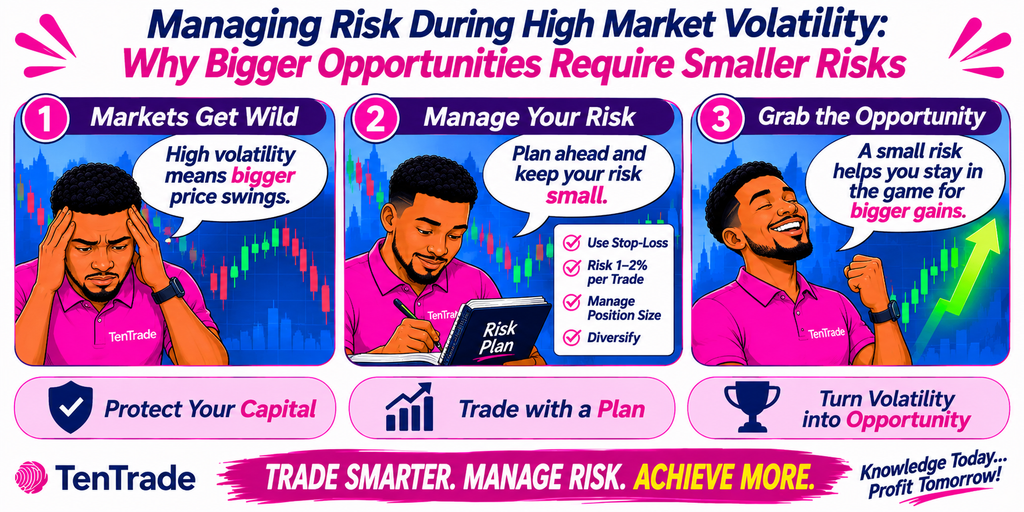
Managing Risk During High Market Volatility: Why Bigger Opportunities Require Smaller Risks

When the Market Moves Faster, Your Risk Management Must Become Smarter!
Imagine this…
You wake up one morning, open your trading account, and notice that Gold (XAUUSD) is moving aggressively. Within a few minutes, the price jumps several dollars, pulls back sharply, and then shoots in the opposite direction.
Your trading group is buzzing. Everyone is talking about the incredible opportunities in the market. One trader posts a screenshot showing a $500 profit, while another claims to have doubled their account.
You feel the pressure. You don’t want to miss out.
So, you increase your lot size, enter the market without waiting for confirmation, and convince yourself that this is your moment.
At first, everything looks perfect. Your trade moves into profit, and you’re already imagining what you’ll do with the money.
Suddenly, the market reverses!
Your floating profit disappears, your stop-loss gets triggered, and a significant portion of your account is gone.
What happened?
You weren’t necessarily wrong about the market direction. You simply underestimated the risk that came with the volatility.
Welcome to one of the biggest lessons in trading: The bigger the market opportunity, the more carefully you must manage your risk.
The Market Is Not Always Moving at the Same Speed
Think of the financial market like driving a car.
Driving at 40 km/h on a quiet road is very different from driving at 120 km/h on a busy highway. The faster you move, the more attention, control and caution you need.
The same principle applies to trading.
During normal market conditions, price movements may be relatively predictable. However, during major economic announcements, interest rate decisions, inflation reports or unexpected geopolitical events, the market can become extremely volatile.
Gold might move aggressively within minutes. EURUSD could experience sudden price spikes, while indices may swing sharply in both directions.
These movements create opportunities, but they also increase the possibility of unexpected losses.
The mistake many traders make is assuming that bigger price movements automatically mean bigger profits.
They forget that bigger movements can also mean bigger losses.
Meet Daniel: The Trader Who Wanted to Make It Big
Daniel had a $1,000 trading account and usually risked 1% per trade, meaning he was comfortable losing a maximum of $10 on a single setup.
One Friday, an important US economic announcement was scheduled.
Gold was moving aggressively, and Daniel noticed that the market was presenting several trading opportunities.
His friend Michael called him.
“Daniel, why are you trading with such small lot sizes? Look at how much Gold is moving! This is the time to make serious money!”
Daniel became tempted.
Instead of maintaining his usual risk management approach, he increased his position size significantly.
Unfortunately, the market moved against him.
Within minutes, Daniel lost $150.
Michael, on the other hand, had reduced his position size, adjusted his stop-loss according to market conditions and waited for confirmation before entering.
He made a smaller profit, but protected most of his capital.
Daniel learned something important that day:
You don’t have to make the most money when the market is moving fast. You have to make sure you don’t lose more than you can afford.
Why Bigger Opportunities Require Smaller Risks
Let’s break this down with a simple example.
Suppose you have a $1,000 trading account.
During normal market conditions, you decide to risk 1% of your account, which is $10.
Now, imagine that volatility increases significantly ahead of a major economic announcement.
Rather than increasing your lot size because the market is moving faster, you could reduce your risk to 0.5%, or $5, depending on your trading strategy and conditions.
Why?
Because sudden price movements, wider spreads, slippage and unexpected reversals can make trading more dangerous.
Reducing your position size helps you maintain control over your potential losses.
Remember, your stop-loss distance and lot size should work together. A wider stop-loss does not automatically mean you should risk more money.
5 Risk Management Rules Every Trader Should Remember
1. Reduce Your Lot Size When Volatility Increases
Don’t allow excitement to determine your position size. If the market becomes more unpredictable, consider reducing your exposure.
2. Always Use a Stop-Loss
A stop-loss is not a sign of weakness. It is a tool that helps you define your potential loss before entering a trade. However, remember that slippage can cause execution beyond your intended level.
3. Avoid Chasing Every Market Movement
Just because Gold moves $20 in a few minutes doesn’t mean you must participate. Sometimes, the best trade is the one you don’t take.
4. Don’t Revenge Trade
After experiencing a loss, avoid immediately entering another position just to recover your money. The market doesn’t owe you a winning trade.
5. Protect Your Capital First
Your trading capital is your business capital. Once you lose a significant portion of it, recovering becomes much harder.
For example, if you lose 50% of a $1,000 account, you need a 100% return on the remaining $500 just to get back to your starting balance.
The Biggest Lesson: You Don’t Get Paid for Taking the Biggest Risk!
Many traders enter the financial markets with one goal: to make money as quickly as possible.
But experienced traders understand that consistency is built through discipline, patience and effective risk management.
The market will always present another opportunity. There will always be another Gold movement, another currency breakout and another economic announcement.
You don’t need to catch every move.
You need to protect your account long enough to participate in the next opportunity.
Remember: High volatility can create bigger opportunities, but it should never become an excuse to abandon your risk management strategy.
Trade smart. Manage your exposure. Protect your capital.
Because the goal isn’t just to make money today. It’s to stay in the game tomorrow.