Why Managing Losses Is More Important Than Finding Winners

In trading, many people spend most of their time searching for the perfect strategy—the best indicator, the perfect entry, or the secret setup that never loses.
But here is the reality:
A good strategy can make you money, but good risk management keeps you in the game long enough to make money.
Think of trading like driving a car. Your trading strategy is the engine that moves you forward but risk management is the brake and seatbelt. Having a powerful engine means little if you cannot control the car.
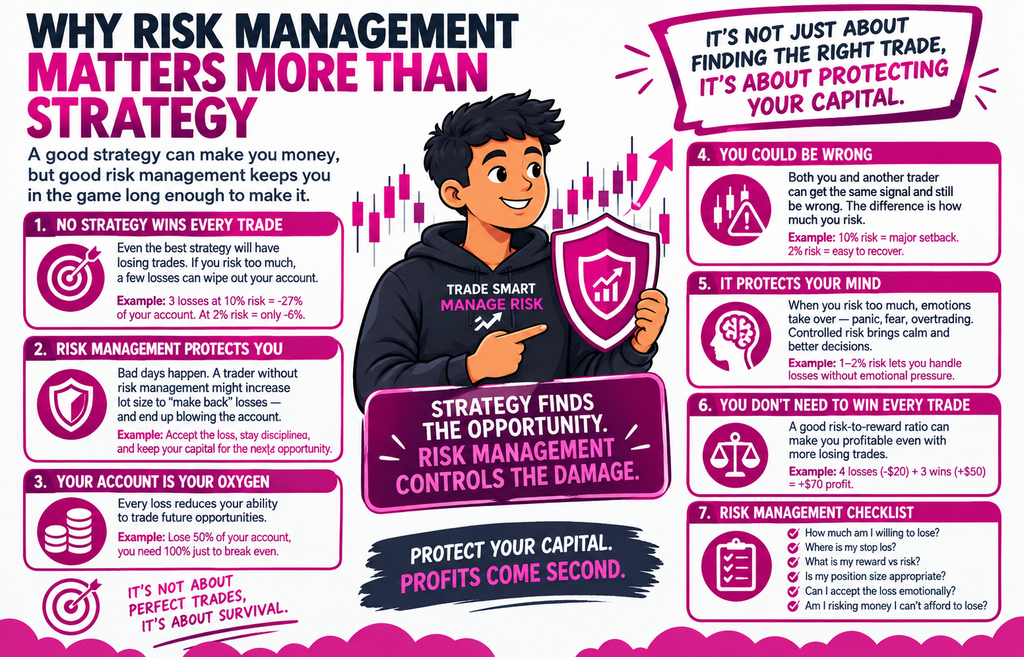
No Strategy Wins Every Trade
Even the best trading strategy will experience losing trades.
For example, imagine you have a strategy that wins 6 out of 10 trades. You could still lose money if you risk too much on the 4 losing trades.
Suppose you have a $1,000 account and risk 10% per trade.
After just three consecutive losses:
$1,000 → $900 → $810 → $729
You have lost 27% of your account.
Now imagine risking only 2% per trade. Three consecutive losses would reduce the account to roughly $941.
The difference is huge.
Risk Management Protects You From Bad Days
Every trader has bad days.
You may misread the market, enter too early, overtrade, or experience several losing trades in a row.
A trader without risk management might think:
“I need to make my money back.”
So they increase their lot size. Then another trade loses. They increase the lot size again.
This is how a small loss can become a blown account.
A disciplined trader accepts the loss and says:
“It was one trade. I still have capital for the next opportunity.”
Your Account Is Your Trading Oxygen
Imagine a football team with only 11 players. If they constantly lose players and have no substitutes, eventually they cannot continue playing.
Your trading capital works in a similar way.
Every loss reduces your ability to participate in future opportunities.
If you lose 50% of your account, you need a 100% return just to get back to where you started.
That is why protecting capital should come before chasing profits.
Strategy Finds the Opportunity — Risk Management Controls the Damage
Consider two traders who receive exactly the same trading signal.
Trader A: Risks 10% of their account.
Trader B: Risks 2%.
The trade hits the stop loss. Both traders were wrong.
But their consequences are completely different.
Trader A has suffered a major setback, while Trader B can simply review the trade and wait for the next setup.
Being wrong is part of trading. Losing control is the real problem.
Risk Management Also Protects Your Mind
Trading is not only about charts. It is also about psychology.
When you risk too much, every trade becomes emotionally important.
A small market movement can make you panic:
“Should I close?”
“Should I add more?”
“Maybe the market will reverse.”
But when your risk is controlled, you can make decisions more calmly.
For example, risking 1–2% allows you to accept a losing trade without feeling that your entire financial future depends on it.
You Don’t Need to Win Every Trade
A professional trader does not need a strategy that wins 90% of the time.
Imagine this simple system:
- 4 losing trades × -$20 = -$80
- 3 winning trades × +$50 = +$150
Total: +$70
The trader lost more trades than they won, yet still made money because their risk-to-reward relationship was favorable.
This is one of the biggest lessons in trading:
You don’t need to predict every move. You need to manage the moves you get wrong.
The Simple Risk Management Checklist
Before entering a trade, ask yourself:
How much am I willing to lose?
Where is my stop loss?
What is my potential reward compared with my risk?
Is my position size appropriate?
Can I emotionally accept the loss?
Am I risking money I cannot afford to lose?
If you cannot answer these questions, the trade may not be ready.
Strategy Gets You Into the Game. Risk Management Keeps You There.
A powerful strategy with poor risk management can destroy an account.
An average strategy with excellent risk management can survive long enough to improve.
The goal is not to avoid every losing trade. The goal is to make sure one losing trade—or even a losing streak—does not destroy your ability to trade tomorrow.
Remember:
“Protect your capital first. Profits come second.”