What Is Trading Risk Management?

Trading is not just about finding the perfect entry. It is also about making sure one bad trade does not destroy all the good trades you have made.
That is where risk management comes in.
Think of trading like driving a car. You may be an excellent driver, but you still wear a seatbelt, follow speed limits and keep your eyes on the road because you know accidents can happen. Risk management is the seatbelt of trading.
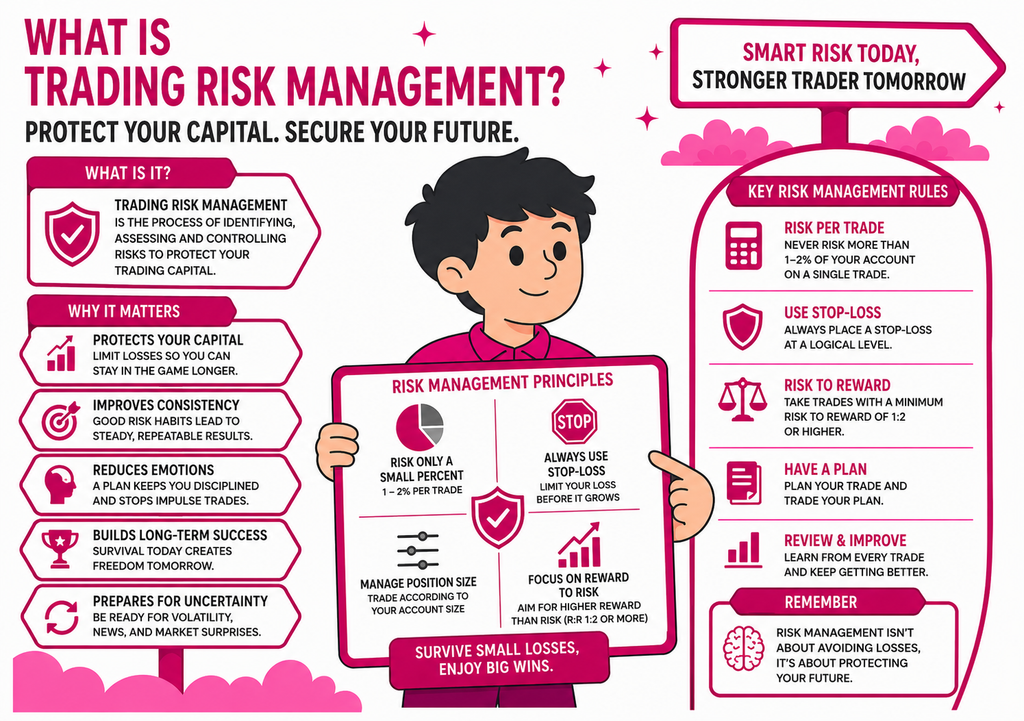
What Exactly Is Trading Risk Management?
Trading risk management is the process of controlling how much money you are willing to lose on each trade and protecting your trading account from excessive losses.
For example, imagine you have a $1,000 trading account. Instead of putting the entire $1,000 at risk on one trade, you decide to risk only 1%, which is $10.
If the trade goes against you, your planned maximum loss is $10.
This means you can experience several losing trades without immediately wiping out your account.
Why Does It Matter?
Even the best traders lose trades.
Imagine a trader makes five trades:
- Trade 1: ✅ +$30
- Trade 2: ❌ -$10
- Trade 3: ❌ -$10
- Trade 4: ✅ +$25
- Trade 5: ❌ -$10
The trader still finishes with a $25 profit, despite having three losing trades.
The lesson? You don’t need to win every trade. You need to manage your losses well enough to survive until the profitable opportunities come.
The Importance of Stop Loss
A stop-loss is one of the most important tools in risk management.
Suppose you buy EUR/USD because you expect the price to rise. Instead of simply hoping the trade works, you decide beforehand where you will exit if you are wrong.
That level becomes your stop loss.
It is like telling yourself:
“If the market reaches this point, my trading idea is no longer valid, so I will accept the loss and move on.”
This prevents a small loss from becoming a much bigger one.
Risk-to-Reward: Don’t Just Ask “How Much Can I Make?”
Good risk management also means considering the potential reward compared with the amount you are risking.
For example, if you risk $10 to potentially make $30, your risk-to-reward ratio is 1:3.
You are risking $1 for a potential $3 return.
This doesn’t guarantee that the trade will win, but it helps you structure trades where the potential reward can justify the risk.
Avoid Putting Everything on One Trade
Imagine you have $1,000 and decide to risk $500 on one trade because you are “very confident.”
The trade loses.
Now you have only $500 left and you need a 100% return just to get back to your original $1,000.
That’s why experienced traders focus on survival first, growth second.
Risk Management Is Also About Your Emotions
Without a risk plan, emotions can quickly take over.
A trader loses $20 and thinks:
“I need to make that money back immediately.”
So they increase their lot size.
Another trade loses $50.
Now they increase it again.
This is how revenge trading can turn a manageable loss into a major account drawdown.
A proper risk-management plan creates rules that you follow before emotions take control.
The Golden Rule
Before entering any trade, know:
How much am I willing to lose? Where will I exit if I’m wrong? What is my potential reward? How does this trade fit into my overall account risk?
Trading risk management will not prevent losses and it cannot guarantee profits.
But it can help you protect your capital, stay in the game, control your emotions and give your trading strategy the opportunity to work over time.
Because in trading, making money is important but protecting your ability to keep trading is just as important.