Understanding Currency Pairs, Gold, Indices, Oil & Crypto

The financial markets can look confusing at first. You see EUR/USD, XAU/USD, NASDAQ, Oil, Bitcoin and wonder: What exactly am I trading?
Think of the market like a huge shopping mall. Different markets are different stores and each one has its own products, behavior and opportunities. Once you understand what you’re looking at, the charts start making much more sense.
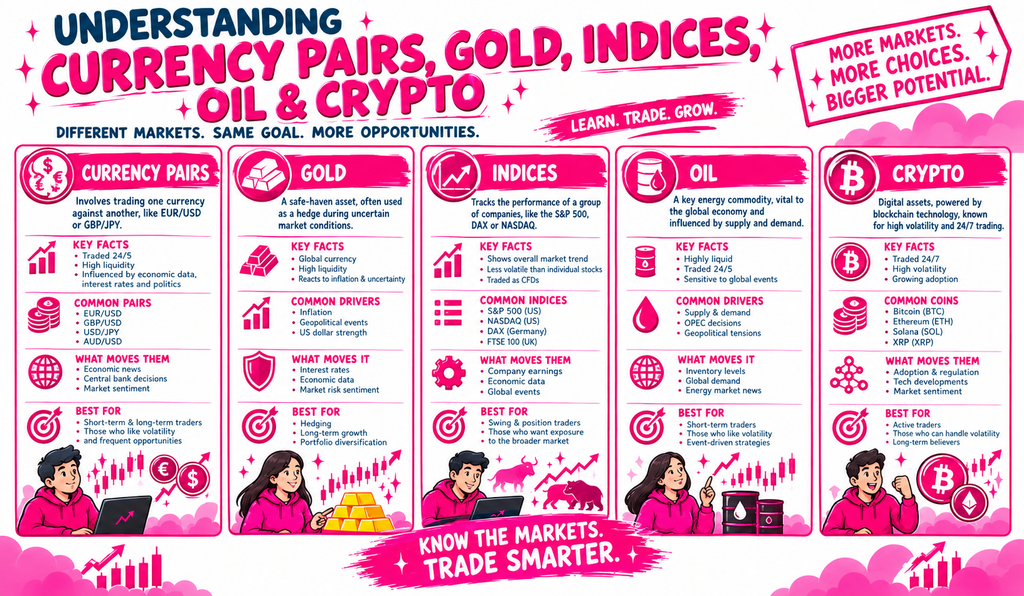
Currency Pairs — Trading One Currency Against Another
Forex involves trading one currency against another.
For example, EUR/USD compares the euro with the US dollar. If you buy EUR/USD, you’re essentially expecting the euro to become stronger relative to the dollar.
Imagine exchanging money before travelling. If $1 buys fewer euros today than it did yesterday, the value relationship has changed. Forex traders try to understand and trade these changes.
Other popular pairs include GBP/USD, USD/JPY and AUD/USD.
Gold — More Than Just Jewelry
Gold, commonly represented as XAU/USD, is one of the most popular instruments among traders.
Think about gold as a financial “safe-haven” asset. When investors become concerned about economic uncertainty, inflation, interest rates or geopolitical events, gold can attract significant attention.
For example, imagine investors becoming nervous about the economy. Demand for gold may increase, potentially creating large price movements.
But remember: gold can move quickly, so risk management is essential.
Indices — A Snapshot of the Market
An index represents a group of companies rather than a single company.
For example, the S&P 500 tracks major US companies, while the NASDAQ-100 focuses heavily on large non-financial companies.
Think of an index like a football team’s scoreboard. Instead of watching one player, you get a broader picture of how the team is performing.
When major economic data or company earnings surprise the market, indices can react sharply.
Oil — The Fuel Behind the Global Economy
Oil is one of the world’s most important commodities.
Its price can be influenced by supply, demand, geopolitical developments, production decisions and global economic activity.
Imagine a sudden disruption in oil supply while demand remains strong. Buyers may compete for limited supply, potentially pushing prices higher.
On the other hand, weaker global demand can put pressure on oil prices.
Crypto — The Digital Revolution
Cryptocurrencies such as Bitcoin and Ethereum have created an entirely new category of financial markets.
Unlike traditional currencies issued by central banks, many cryptocurrencies operate on blockchain networks.
Crypto markets are known for being highly volatile. A move that would seem huge in another market can sometimes happen within hours in crypto.
Imagine buying an asset at $50,000 and seeing it move to $55,000 quickly. Exciting? Absolutely. But the same volatility can work against you just as quickly.
One Market, Different Personality
Each market has its own personality:
Forex → Currency relationships
Gold → Precious metal and safe-haven demand
Indices → Groups of major companies
Oil → Global energy commodity
Crypto → Digital assets and blockchain technology
The key is not to trade everything simply because it’s available. Understand what moves the market you’re trading.
A trader who understands why an asset moves is better equipped to interpret its chart, manage risk and avoid blindly chasing price.
The Bottom Line
Trading isn’t just about seeing a green or red candle and clicking BUY or SELL.
It’s about understanding the asset behind the chart.
Know what you’re trading. Understand what drives its price. Study its behavior. And most importantly, manage your risk.
Because in trading, the goal isn’t simply to catch the biggest move , it’s to stay in the game long enough to catch the next one.