The Market Doesn’t Owe You a Trade – Mastering the Art of Doing Nothing

Have you ever opened your trading platform, watched the market move and felt uncomfortable because you weren’t part of the action? Perhaps Gold is rising, EURUSD is dropping or Bitcoin is making a sudden move and you feel like everyone is making money except you.
That feeling is familiar to many traders. But here’s a powerful truth: You don’t have to trade every day to become a successful trader. Sometimes, your best trade is the one you never take.
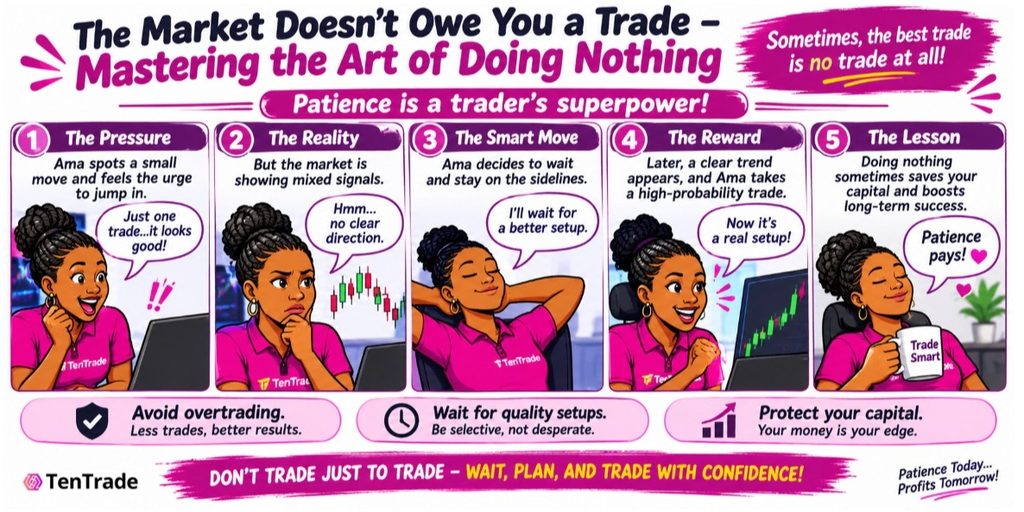
Ama’s Story: The Day Doing Nothing Saved Her Account
Ama had been trading Forex for about six months. Every morning, she woke up excited to check the charts, hoping to find an opportunity to make money.
One Tuesday morning, she noticed Gold (XAUUSD) moving strongly upwards. Excited by the momentum, she immediately wanted to BUY.
However, her trading strategy required her to wait for price to pull back to a support zone and show bullish confirmation before entering.
Unfortunately, Gold kept rising without giving her the setup she wanted.
Ama became frustrated. She thought to herself, “If I keep waiting, I’ll miss the entire move. Other traders are probably making money already!”
Unable to control her emotions, she entered a BUY position at a much higher price than planned.
A few minutes later, Gold reversed sharply and her trade hit its stop loss.
Disappointed, Ama decided to recover her loss immediately. She entered another trade without proper analysis, hoping the market would give her back what she had lost.
Unfortunately, she lost again.
That evening, Ama reviewed her trading journal and discovered something interesting: her losses were not necessarily caused by poor market analysis. They were caused by impatience, FOMO and the desire to trade even when her conditions were not met.
The following day, Ama made a different decision.
She opened her charts, analysed the market and waited. Gold moved up and down, but none of the movements met her trading criteria.
Instead of forcing a trade, she closed her platform and went about her day.
She made no money from trading that day, but she also lost nothing.
For the first time, Ama understood that staying out of the market was not a sign of weakness. It was an act of discipline.
The Danger of Feeling You Must Trade Every Day
One of the biggest mistakes traders make is believing they must enter at least one trade every day.
Imagine a farmer who plants seeds every morning, even when the weather and soil conditions are unsuitable. Eventually, some of those seeds will be wasted.
Trading works in a similar way. Not every market condition is suitable for your strategy.
Sometimes, the market is moving sideways, volatility is too high, or price has not reached your preferred entry zone.
A professional trader understands that opportunities must meet certain conditions before money is put at risk.
Remember:
Your job is not to trade every market movement. Your job is to identify quality opportunities.
FOMO: The Fear of Missing Out
FOMO is one of the biggest enemies of trading discipline.
For example, imagine Gold suddenly rises by $30. You were not in the trade, but after seeing the movement, you rush to BUY because you believe it will continue rising.
Unfortunately, you enter just before the market begins to pull back.
This is how traders often buy at the top or sell at the bottom.
The problem is not that you missed the opportunity. The problem is allowing the missed opportunity to influence your next decision.
There will always be another setup. You don’t need to chase the one that has already happened.
Doing Nothing Is Also a Trading Decision
Many traders associate success with constant activity. They believe that more trades mean more opportunities to make money.
But imagine two traders:
- Trader A takes 10 trades in one day, risking money on several setups without proper confirmation.
- Trader B waits patiently, identifies one high-quality opportunity and risks only 1% of their account.
Trader B may have fewer trades, but their approach is more structured and controlled.
The objective is not to measure success by how many times you click BUY or SELL. It is to measure it by how consistently you follow your trading plan.
Learn to Accept Missed Opportunities
One of the hardest lessons in trading is accepting that you cannot catch every move.
Imagine seeing your favourite bus leave just as you arrive at the station. You may feel disappointed, but running after it in traffic could create a bigger problem.
The sensible decision is to wait for the next bus.
The same principle applies to trading. If you miss an entry, don’t chase the price. Wait for another opportunity that meets your strategy.
The market will continue operating tomorrow, next week and next month. You don’t have to risk your account because you missed one movement.
Protecting Your Capital Is More Important Than Being Active
Every trade exposes your account to risk. Therefore, entering unnecessary positions increases your exposure without necessarily improving your chances of success.
Consider a trader with a $1,000 account who risks 2% per trade. That means they are willing to lose $20 on a properly planned position.
If they force five unnecessary trades and lose each one, they could lose $100, representing 10% of their account.
Imagine how much damage impatience can cause over several trading sessions.
Sometimes, preserving your capital is the greatest achievement of the day.
How to Master the Art of Doing Nothing
Here are six practical habits that can help you become a more patient trader:
- Create a trading plan: Know your entry, stop-loss and take-profit conditions before entering a position.
- Wait for confirmation: Don’t enter simply because price is moving.
- Set daily trading limits: Avoid taking unnecessary positions just to remain active.
- Control your emotions: Recognise when FOMO, greed or frustration is influencing your decisions.
- Keep a trading journal: Record missed setups, emotional decisions and days when you successfully avoided unnecessary trades.
- Accept no-trade days: Understand that staying out of the market is part of a disciplined trading strategy.
Final Thoughts: You Don’t Get Paid for Clicking Buttons
Ama eventually learned that trading was not about being active every minute. It was about being patient enough to recognise the right opportunity and disciplined enough to walk away when conditions were not favourable.
The financial markets will always create movements, but not every movement deserves your money.
You don’t have to catch every bullish candle, sell every bearish move or recover every missed opportunity.
Sometimes, the smartest thing you can do is close your laptop, protect your capital and wait for a better setup.
The market doesn’t owe you a trade. You owe yourself discipline, patience and proper risk management.
#TradingPsychology #TheArtOfDoingNothing #TradingDiscipline #MasterYourMind #PatienceInTrading #AvoidOvertrading #ForexTrading #SmartTrading #RiskManagement #TradeYourPlan #TenTrade