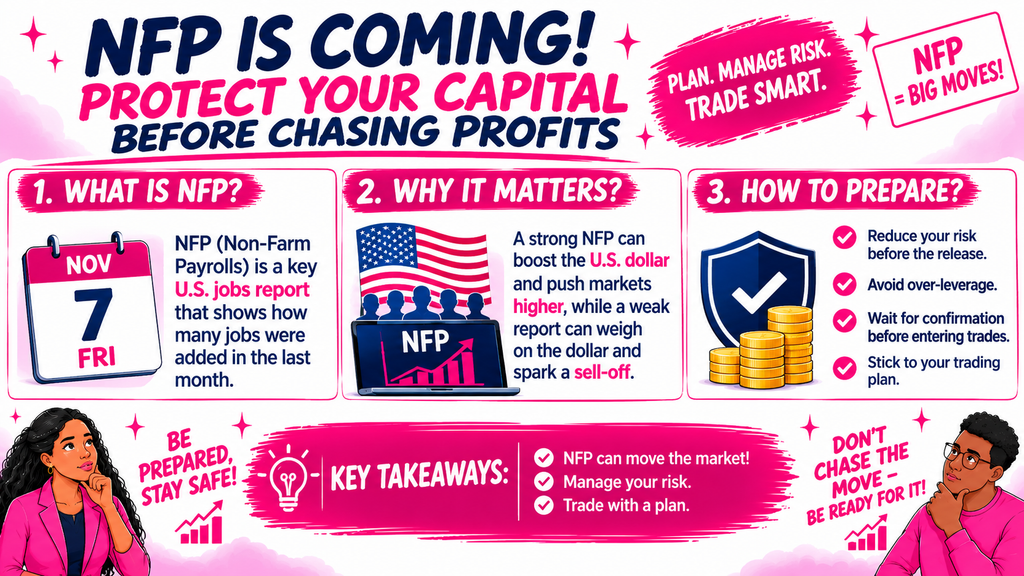
NFP Is Coming! Protect Your Capital Before Chasing Profits

One economic announcement can create incredible trading opportunities, but one careless decision can wipe out weeks or even months of trading progress. Are you prepared to protect your account when the market gets wild?
The Day Kofi Tried to Become a Millionaire Overnight
It was Friday afternoon and Kofi was excited. He had been waiting all week for the US Non-Farm Payrolls (NFP) announcement.
With $1,000 in his trading account, he believed this was his opportunity to make some serious money.
He opened his economic calendar, saw that NFP was approaching and noticed that Gold (XAUUSD) was moving.
Kofi thought to himself:
“If I can catch just one big move today, I could make $200 or even $300!”
He increased his lot size, ignored his usual risk management rules and opened a BUY position just before the announcement.
Suddenly, the news was released.
Gold started moving aggressively. Within seconds, the price reversed and Kofi’s account suffered a significant loss.
The worst part? He had spent weeks building that account but one emotional decision had destroyed a large portion of his progress.
Meanwhile, another trader, Ama, was also watching the same NFP announcement.
But Ama had a different approach.
She had already calculated her position size, identified her stop loss and decided how much she was willing to risk. She waited for the initial market reaction to settle before looking for a potential trading opportunity.
Both traders watched the same market, but their decisions produced very different outcomes.
The lesson? Successful trading is not just about finding opportunities. It is also about knowing how to protect yourself when things go wrong.
What Makes NFP So Important?
Non-Farm Payrolls is one of the most closely watched economic reports in the United States.
It measures changes in employment across most sectors of the US economy, excluding agricultural workers, private household employees and certain other categories.
The report provides clues about the health of the US economy and can influence expectations about Federal Reserve interest-rate decisions.
When the figures differ significantly from market expectations, financial markets can react sharply.
For example:
- Stronger-than-expected employment: Could support the US dollar if investors anticipate higher interest rates.
- Weaker-than-expected employment: Could put pressure on the dollar if investors expect interest-rate cuts.
- Unexpected wage growth: Could influence inflation expectations and market sentiment.
However, remember that markets react to the complete employment picture, including unemployment, wage growth and previous revisions not just the headline number.
This is why Gold, EURUSD, GBPUSD, USDJPY and US stock indices can experience increased volatility around NFP.
Never Risk Your Entire Account for One Opportunity
Imagine you have $1,000 in your trading account.
You decide to risk 20% because you believe NFP will move the market in your favour.
If the trade loses, you immediately lose $200.
Now imagine another trader who risks just 2%.
That trader risks only $20 on the same account balance.
Look at the difference:
| Trading approach | Risk per trade | Money at risk |
| Aggressive trader | 20% | $200 |
| Disciplined trader | 5% | $50 |
| Conservative trader | 2% | $20 |
| Very conservative trader | 1% | $10 |
A smaller risk does not guarantee profits, but it gives you more room to withstand losing trades.
Remember:
Your first responsibility as a trader is to stay in the game.
Understand Your Position Size Before Entering
One common mistake traders make during NFP is opening positions without calculating how much they could lose.
Let’s use Ama’s example.
She has $1,000 in her account and decides to risk 1% on a potential Gold trade.
Her maximum planned risk is $10.
Before entering, she determines her stop-loss distance and calculates the appropriate lot size based on the instrument’s contract specifications.
This means she knows approximately how much she stands to lose if the stop loss is triggered.
She doesn’t choose a lot size because it looks attractive. She chooses it because it matches her risk plan.
Key lesson:
Always calculate your position size using your account balance, risk percentage, stop-loss distance and the instrument’s value per price movement.
Stop Loss Is Your Safety Net, Not Your Enemy
Some traders avoid using stop losses because they hate being stopped out.
But imagine driving from somewhere without checking your fuel level, brakes or vehicle condition.
You might reach your destination, but you are taking unnecessary risks.
Trading without a stop-loss plan is similar.
A stop loss helps you define where your trading idea is no longer valid.
For example:
You enter a BUY trade on Gold at $4,100, with a planned stop loss at $4,090.
Your trade idea is invalidated if the market reaches your stop-loss level.
However, during major news events, prices can move rapidly and slippage may cause an execution price different from your requested stop-loss price.
That is why traders should also consider position size, spreads and market liquidity.
Avoid Revenge Trading After an NFP Loss
Let’s return to Kofi.
After losing $200, he becomes frustrated.
Instead of stepping away, he opens another trade to recover his money.
Unfortunately, the second trade also goes against him.
He then increases his lot size again, hoping to recover everything.
This is called revenge trading.
It happens when emotions take control of trading decisions.
The problem is that the market does not know you lost money. It does not owe you a winning trade.
If you experience a loss:
- Accept it as part of trading.
- Avoid immediately increasing your lot size.
- Review what went wrong.
- Take a break if emotions are affecting your decisions.
- Return only when you have a clear trading plan.
Never allow the desire to recover a loss to create an even bigger loss.
Five Things to Do Before Trading NFP
Before the announcement, ask yourself these five questions:
- Have I checked the economic calendar and market expectations?
- Do I understand the current market trend?
- Have I identified important support and resistance levels?
- Have I calculated my position size and maximum acceptable loss?
- Am I prepared to stay out of the market if conditions become too unpredictable?
If you cannot confidently answer these questions, there is no need to rush into a trade.
Sometimes, the best trading decision is not to trade at all.
Your NFP Trading Survival Checklist
Before opening your next position, remember:
- Trade with a clear strategy, not excitement.
- Avoid excessive leverage.
- Risk only a small, predefined percentage of your account.
- Use appropriate stop losses.
- Watch out for spreads and slippage.
- Avoid opening multiple highly correlated positions.
- Never chase the market after a sudden move.
- Protect your capital before thinking about profits.
Final Thoughts: The Best Traders Know When to Protect Their Money
Kofi and Ama watched the same NFP announcement, analysed the same Gold chart and had access to the same trading opportunities.
But one focused on how much he could make, while the other focused on how much she could afford to lose.
That difference matters.
Trading is not a competition to see who can make the most money in five minutes. It is a long-term journey that requires patience, discipline, strategy and proper risk management.
You do not have to catch every market move to become a better trader.
You only need to identify opportunities that fit your strategy and manage the risks responsibly.
This Friday, before asking how much you can make from NFP, ask yourself how much you are prepared to lose.
Because remember:
Protect your capital today so you can trade another day.
#NFPTrading #RiskManagement #ProtectYourCapital #ForexTrading #GoldTrading #XAUUSD #TradingPsychology #PositionSizing #StopLoss #TenTrade