Fear in Trading: When Your Mind Becomes Your Biggest Risk

Imagine you analyse a trade perfectly. You identify the trend, mark your entry, set your stop-loss and target. Everything looks good.
Then the price starts moving toward your entry.
Suddenly, your heart starts beating faster.
You think: “What if I lose?”
You hesitate.
The setup triggers without you.
A few minutes later, price moves exactly in the direction you expected.
Frustrating, right?
This is the power of fear in trading.
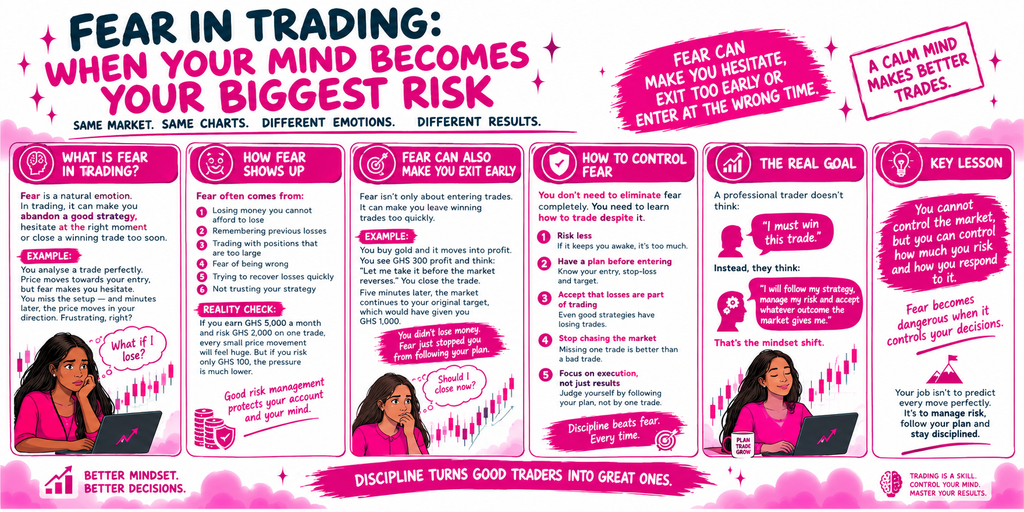
Fear Can Make Good Traders Make Bad Decisions
Fear is a natural human emotion. In trading, however, it can cause you to abandon a perfectly good strategy.
For example, imagine you plan to buy gold at $4,300, with a stop-loss at $4,280 and a target at $4,340.
Price reaches $4,300, but you remember your last losing trade.
You hesitate.
Price moves to $4,310.
Now you feel you are missing out, so you enter late at $4,310.
Then the market pulls back to $4,290.
You panic and close the trade at a loss.
Minutes later, gold moves to $4,340.
The problem wasn’t necessarily your analysis.
Fear changed your execution.
Where Does Trading Fear Come From?
Fear often comes from:
- Losing money you cannot afford to lose
- Remembering previous losses
- Trading with positions that are too large
- Fear of being wrong
- Trying to recover losses quickly
- Not trusting your trading strategy
Consider someone earning GHS 5,000 a month but risking GHS 2,000 on one trade.
Every small price movement will feel enormous.
But if that same trader risks only GHS 100, the emotional pressure is much lower.
Good risk management doesn’t just protect your account—it protects your mind.
Fear Can Also Make You Exit Too Early
Fear isn’t only about entering trades.
It can also make you leave winning trades too quickly.
You buy gold and it moves into profit. You see GHS 300 profit and think:
“Let me take it before the market reverses.”
You close the trade.
Five minutes later, the market continues to your original target, which would have given you GHS 1,000.
You didn’t lose money.
But fear prevented you from following your plan.
How Do You Control Fear?
You don’t need to eliminate fear completely.
You need to learn how to trade despite it.
Try these simple rules:
1. Risk less
If the amount you are risking keeps you awake at night, your position is probably too large.
2. Have a plan before entering
Know your entry, stop-loss and target before clicking Buy or Sell.
3. Accept that losses are part of trading
A losing trade doesn’t automatically mean you are a bad trader. Even a good strategy produces losing trades.
4. Stop chasing the market
Missing one trade is better than entering a bad trade because of FOMO.
5. Focus on execution, not individual results
Judge yourself by whether you followed your trading plan—not simply by whether one trade won or lost.
The Real Goal
A professional trader doesn’t think:
“I must win this trade.”
Instead, they think:
“I will follow my strategy, manage my risk and accept whatever outcome the market gives me.”
That’s the mindset shift.
Fear becomes dangerous when it controls your decisions.
Your job as a trader isn’t to predict every move perfectly.
Your job is to manage risk, follow your plan and stay disciplined when the market tests your emotions.
Key Lesson
You cannot control the market, but you can control how much you risk and how you respond to it.