Leverage Is a Double-Edged Sword: How Excessive Exposure Wipes Out Trading Accounts

One small account. One big opportunity. One costly mistake. Kofi thought leverage was his shortcut to financial freedom, until the market taught him a lesson he would never forget.
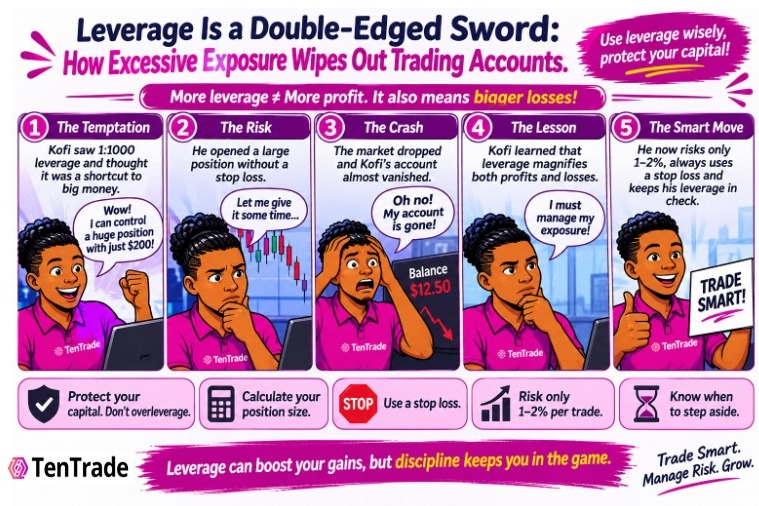
The Day Kofi Discovered the Power of Leverage
Kofi had been trading forex for almost six months. He had watched countless YouTube tutorials, attended webinars and learned how to identify support, resistance and market trends.
One Monday morning, he deposited $200 into his trading account.
His goal was simple: turn $200 into $1,000 as quickly as possible.
While scrolling through his trading platform, he noticed something exciting: his broker offered leverage of up to 1:1000.
“Wow! With just $200, I can control a much bigger trading position. This is my opportunity!” Kofi exclaimed.
He immediately became excited. Instead of seeing leverage as a tool that required careful management, he saw it as a shortcut to making big money.
Unfortunately, he was about to learn an expensive lesson.
The Temptation of Bigger Profits
On Tuesday, Kofi spotted an opportunity to buy Gold (XAUUSD). The market was moving upward and he believed prices would continue rising.
He decided to open a 0.50-lot position.
His confidence was high. He imagined making $100 or even $200 from a single trade.
But there was one problem: Kofi had not calculated how much he could lose if the market moved against him.
Gold suddenly dropped following an unexpected market development.
At first, Kofi ignored the movement.
“Let me give it some time. The market will recover,” he told himself.
But the price continued falling.
Within minutes, his account was experiencing a significant drawdown. He became nervous, started checking his phone every few seconds and eventually watched most of his trading capital disappear.
His $200 account was nearly wiped out.
What went wrong?
Kofi was not necessarily wrong about the market direction in the long run. His biggest mistake was taking a position that was too large for his account.
He had allowed leverage to magnify his exposure beyond what he could comfortably manage.
Understanding the Double-Edged Sword
Leverage allows traders to control larger positions with a relatively small amount of capital.
For example, with 1:100 leverage, a trader can theoretically control a $10,000 position with $100 in margin.
But here is the catch: while leverage increases your market exposure, it also magnifies the financial impact of price movements.
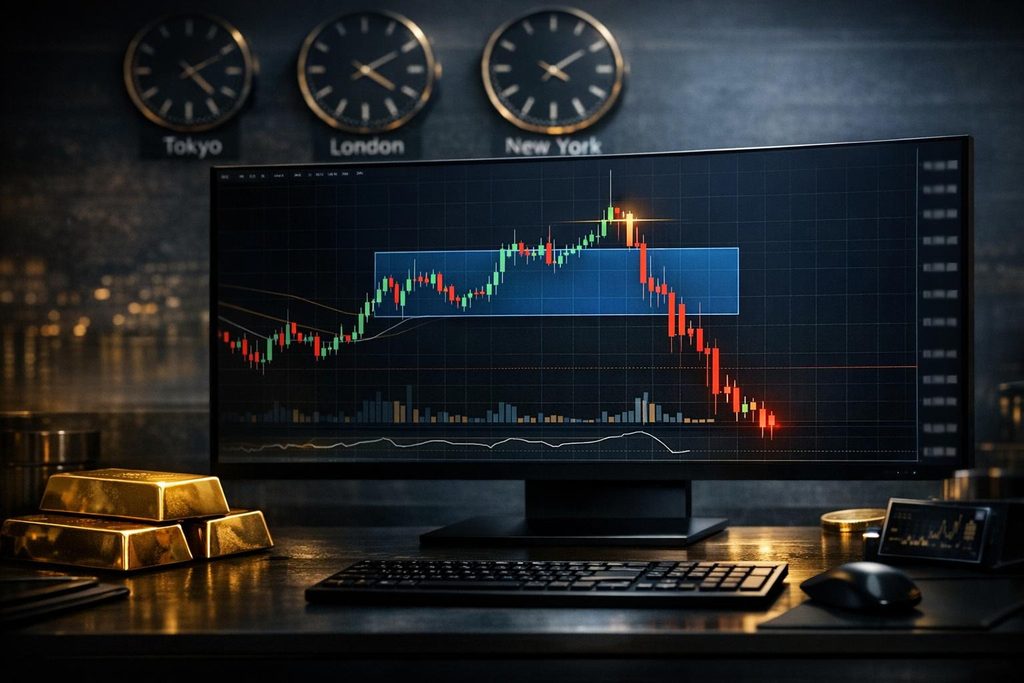
Consider this simple example:
| Account balance | Position exposure | Market movement | Approximate result |
| $200 | $2,000 | +1% | +$20 |
| $200 | $2,000 | -1% | -$20 |
| $200 | $10,000 | +1% | +$100 |
| $200 | $10,000 | -1% | -$100 |
Illustrative calculations excluding spreads, commissions and other trading costs.
Notice something important: the same market movement that creates an attractive profit can also create a devastating loss.
Leverage does not make the market more predictable. It simply increases your exposure to its movements.
Five Mistakes That Can Destroy a Trading Account

Kofi later discovered that his mistake was not unique. Many traders lose their accounts because they make similar decisions.
Using excessive lot sizes
Opening positions that are too large relative to account balance can cause small market movements to create significant losses.
Trading without a stop loss
Without a defined exit point, a losing position can continue accumulating losses until the account faces a margin call or stop-out.
Increasing leverage to recover losses
After losing money, some traders increase their position sizes to recover quickly. This often makes an already difficult situation worse.
Ignoring margin requirements
Traders sometimes focus on how much they can make without understanding how much margin their positions consume.
Opening multiple correlated trades
Buying EURUSD, GBPUSD and AUDUSD simultaneously may appear like three separate opportunities, but these positions can carry similar US dollar exposure.
One unexpected dollar movement could affect all three trades.
How Kofi Changed His Trading Strategy
After losing most of his account, Kofi decided to approach trading differently.
He stopped chasing large profits and started focusing on protecting his capital.
Here are five rules he adopted:

Risk 1–2% per trade:
On a $200 account, this means risking only $2–$4 on an individual trade.
Calculate lot size before entering:
Position size must reflect the stop-loss distance and the amount he can afford to lose.
Always use a stop loss:
Every trade must have a clearly defined exit point.
Avoid excessive exposure:
Never open positions simply because the broker offers high leverage.
Set a daily loss limit:
Stop trading when the predetermined loss limit is reached.
Kofi also learned an important lesson:
having access to 1:1000 leverage does not mean he must use all of it.
He could have high available leverage while maintaining a much smaller actual position.
The Biggest Lesson: Leverage Is Not Your Enemy, Ignorance Is!
Three months later, Kofi was no longer obsessed with turning $200 into $1,000 overnight.
He understood that successful trading was not about how much money he could make from one trade. It was about how consistently he could manage risk across many trades.
He still used leverage, but he respected it.
Whenever he spotted an opportunity, he asked himself three questions:
- How much am I willing to lose?
- What position size is appropriate for my account?
- Can my account survive if this trade goes against me?
These questions changed his entire approach to trading.
Remember:
Leverage can accelerate your profits, but it can also accelerate your losses. The difference between a disciplined trader and a reckless one is often how they manage their exposure.
Key Takeaways for Every Trader
Before you open your next trade, remember:
Protect your capital before chasing profits.
Calculate your position size before entering.
Understand your margin and total exposure.
Never use excessive leverage to recover losses.
A question for you: Are you controlling your leverage or is your leverage controlling you?
Trade smart. Manage risk. Protect your capital.