The Most Important Candlestick Patterns Every Trader Should Know

Have you ever watched the price of gold rise for hours, only to see it suddenly fall? Or bought Bitcoin expecting a rally, only for the market to turn against you? These situations happen every day in financial markets but understanding candlestick patterns can help you read price movements and make better trading decisions.
Think of candlesticks as the market’s way of telling a story. Every candle shows the battle between buyers and sellers, who is winning, who is losing strength and where the market might move next.
Let’s explore the most important candlestick patterns every trader should understand.
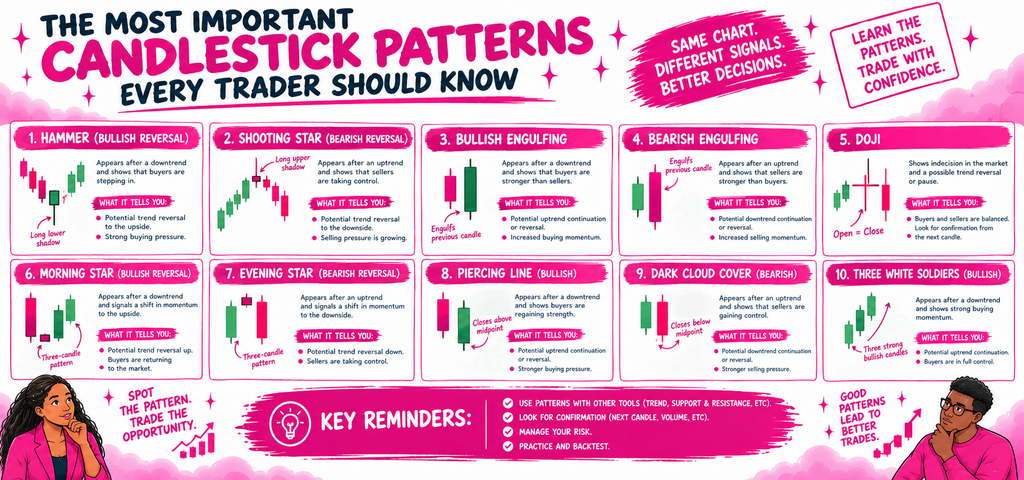
1. The Doji: When the Market Cannot Decide
A Doji forms when the opening and closing prices are almost equal. It shows uncertainty between buyers and sellers.
Real-life example:
Imagine buyers and sellers disagreeing on the price of tomatoes. Neither side wins, and the price barely changes.
What it means in trading:
The market may be losing momentum, especially after a strong upward or downward move.
Trading tip:
Wait for the next candle to confirm the direction before entering a trade.
2. The Hammer: A Possible Bullish Reversal
The Hammer has a small body near the top and a long lower wick. It often appears after a price decline and suggests that buyers are pushing prices back up.
Real-life example:
Gold prices fall sharply but buyers step in and push the price higher before the candle closes. Sellers tried to take control but failed to maintain the lower price.
What it means in trading:
The market may be preparing for an upward reversal.
Trading tip:
Look for a Hammer near a support level and wait for bullish confirmation before considering a BUY.
3. The Shooting Star: A Warning for Buyers
The Shooting Star has a small body near the bottom and a long upper wick. It often appears after an upward move and suggests that sellers are resisting higher prices.
Real-life example:
Bitcoin rises strongly, attracting buyers. However, sellers begin taking profits, pushing the price back down before the candle closes.
What it means in trading:
The upward momentum may be weakening, creating a possible bearish reversal.
Trading tip:
Look for a Shooting Star near resistance and wait for bearish confirmation before considering a SELL.
4. The Bullish Engulfing: Buyers Take Control
A Bullish Engulfing pattern occurs when a strong bullish candle’s body completely covers the previous bearish candle’s body.
Real-life example:
Imagine sellers have been controlling the market all morning. Suddenly, buyers enter with enough strength to push prices above the previous candle’s opening level.
What it means in trading:
Buying pressure may be increasing, potentially signaling an upward reversal.
Trading tip:
Look for this pattern after a downtrend or near support, then confirm the setup before entering a BUY.
5. The Bearish Engulfing: Sellers Fight Back
A Bearish Engulfing pattern occurs when a strong bearish candle’s body completely covers the previous bullish candle’s body.
Real-life example:
Gold has been rising, and traders expect more gains. Suddenly, strong selling pressure pushes the price below the previous candle’s opening level.
What it means in trading:
Sellers may be taking control, potentially signaling a downward reversal.
Trading tip:
Look for this pattern near resistance or after an uptrend, and wait for confirmation before considering a SELL.
6. The Morning Star: A Potential Market Comeback
The Morning Star is a three-candle pattern that can appear after a downtrend. It typically consists of a strong bearish candle, a smaller candle showing indecision, and a strong bullish candle.
Real-life example:
A trader sees gold falling throughout the day. The decline slows, and buyers eventually return with enough strength to push the price higher.
What it means in trading:
Selling pressure may be fading while buying pressure builds.
Trading tip:
Look for the Morning Star near support and confirm that buyers are gaining momentum before considering a BUY.
7. The Evening Star: When the Rally Starts Fading
The Evening Star is the opposite of the Morning Star. It typically consists of a strong bullish candle, a smaller candle showing indecision, and a strong bearish candle.
Real-life example:
Bitcoin has been climbing, but the upward movement slows. Sellers then enter the market, pushing prices lower and challenging the previous rally.
What it means in trading:
Buying pressure may be weakening, potentially opening the door to a downward reversal.
Trading tip:
Watch for this pattern near resistance and wait for bearish confirmation before considering a SELL.
How to Use Candlestick Patterns Like a Professional
Recognizing a candle is only the beginning. Successful trading requires understanding where the pattern forms and what the market is doing.
Check the trend:
A Hammer during a downtrend may carry a different message from one appearing in the middle of a strong rally.
Identify support and resistance:
Patterns near important price levels can provide more meaningful clues.
Wait for confirmation:
One candle cannot guarantee what happens next. Let the following price action support your decision.
Manage your risk:
Decide your stop-loss, target, and position size before entering a trade. Never risk money you cannot afford to lose.
For example, if gold forms a Bullish Engulfing pattern near support, you could wait for the next candle to confirm buying strength. You would then assess a potential entry, place a suitable stop-loss, and calculate your risk before taking the trade.
The Biggest Mistake Traders Make
Many beginners memorize candlestick patterns and immediately enter trades whenever they spot one. Unfortunately, a Hammer does not always lead to a rally, and a Shooting Star does not always cause a decline.
Candlesticks show potential changes in market sentiment—not guaranteed future prices. Their reliability depends on market conditions, location, timeframe, and confirmation.
Final Lesson
Candlesticks tell you what buyers and sellers are doing, but your trading plan determines what you should do next.