Emotions and Their Impact on Trading Decisions

Trading is not only a battle against the market—it is also a battle against yourself.
You can have a solid strategy, good analysis, and a clear trading plan, but one emotional decision can turn a profitable day into a painful loss. Fear, greed, excitement, frustration, and overconfidence can all influence how we enter, manage, and exit trades.
The key is not to eliminate emotions. It is to learn how to manage them.
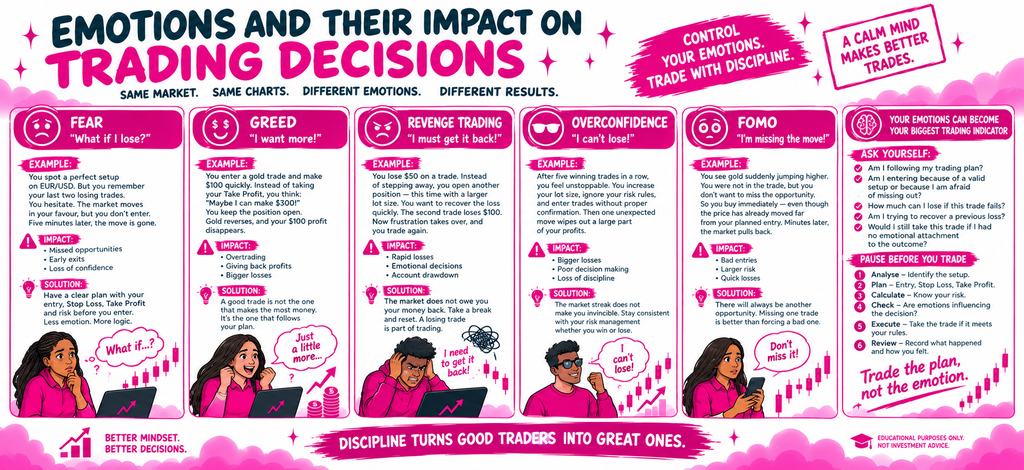
1. Fear: “What If I Lose?”
Imagine you identify a perfect setup on EUR/USD. Your analysis says the conditions are right, but you remember the last two trades you lost.
You hesitate.
The market starts moving in your expected direction, but you still don’t enter. Five minutes later, the move is gone.
Lesson: Fear can stop you from taking valid opportunities—or make you exit good trades too early.
A simple solution is to define your entry, Stop Loss, Take Profit, and risk before entering the trade. When the plan is clear, emotions have less room to take control.
2. Greed: “I Want More!”
Suppose you enter a gold trade and quickly make $100.
Instead of following your Take Profit, you think:
“Maybe I can make $300!”
You keep the position open. Gold reverses, and your $100 profit disappears.
Greed often makes traders abandon their original plan because they want to squeeze more profit from a trade.
Lesson: A good trade is not one that makes the most money. It is one that follows your plan.
3. Revenge Trading: “I Must Get It Back!”
You lose $50 on a trade.
Instead of stepping away, you immediately open another position—this time with a larger lot size because you want to recover the loss quickly.
The second trade loses another $100.
Now frustration takes over, and you trade again.
This is how a small loss can become a major account drawdown.
Lesson: The market does not owe you your money back. A losing trade is part of trading.
When emotions rise, taking a break can be more valuable than taking another trade.
4. Overconfidence: “I Can’t Lose!”
After winning five trades in a row, you may start feeling unstoppable.
You increase your lot size, ignore your risk rules, and enter trades without proper confirmation.
Then one unexpected market move wipes out a large portion of your profits.
Lesson: A winning streak does not make you invincible.
Stay consistent with your risk management whether you have won five trades or lost five.
5. FOMO: “I’m Missing the Move!”
You see gold suddenly jumping higher.
You were not in the trade, but you don’t want to miss the opportunity. So you buy immediately—even though the price has already moved far from your planned entry.
Minutes later, the market pulls back.
You entered because of FOMO—Fear of Missing Out, not because your trading setup was ready.
Lesson: There will always be another opportunity. Missing one trade is better than forcing a bad one.
Your Emotions Can Become Your Biggest Trading Indicator
Before entering a trade, ask yourself:
- Am I following my trading plan?
- Am I entering because of a valid setup or because I am afraid of missing out?
- How much can I lose if this trade fails?
- Am I trying to recover a previous loss?
- Would I still take this trade if I had no emotional attachment to the outcome?
If the answer to these questions makes you uncomfortable, pause before clicking Buy or Sell.
Build a “Pause Before You Trade” Habit
A simple routine can help:
1. Analyze – Identify the market setup.
2. Plan – Define your entry, Stop Loss and Take Profit.
3. Calculate – Know exactly how much you are risking.
4. Check – Ask whether emotions are influencing the decision.
5. Execute – Take the trade only if it meets your rules.
6. Review – Record what happened and how you felt.
Final Thought
Successful trading is not about having no emotions. It is about not allowing emotions to control your decisions.
The market will test your strategy, but it will also test your patience, discipline, and ability to stay calm.
Trade the plan—not the emotion.
Estimated reading time: 4 minutes