What Is Trading Psychology and Why Does It Matter?

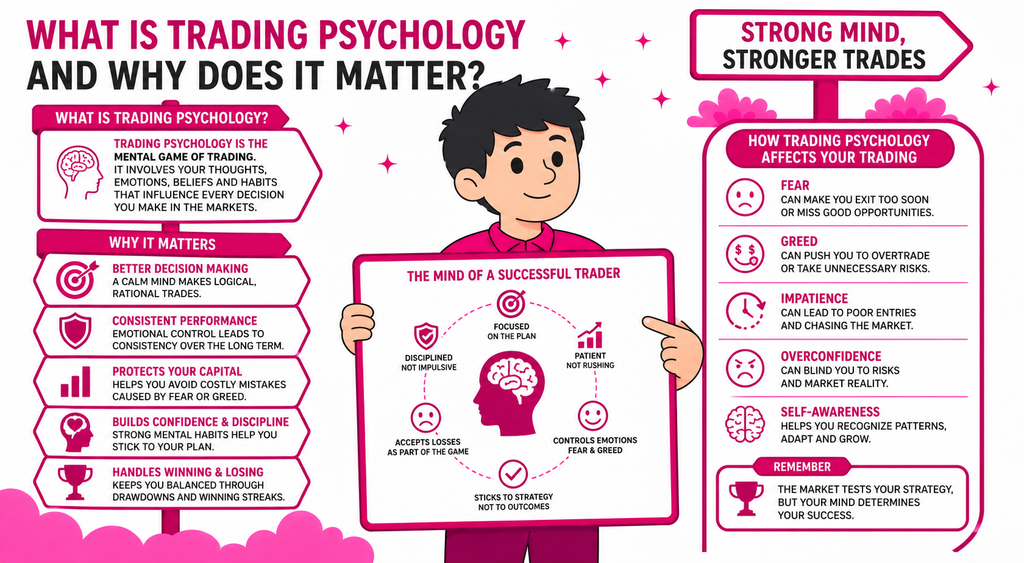
Trading is often described as a game of charts, indicators, strategies and market analysis. But there is another factor that can determine whether a trader follows their plan or destroys it in a few minutes: psychology.
You can have a great strategy, identify a good setup and still lose money because of fear, greed, impatience or overconfidence.
In simple terms, trading psychology is the way your emotions, thoughts and behaviour influence your trading decisions.
The Real Battle Is Often With Yourself
Imagine two traders see exactly the same setup on XAU/USD.
Both identify a potential buy opportunity. Both have the same entry, stop-loss and take-profit.
Trader A risks only 1% of their account and follows the plan.
Trader B is convinced gold will rise, so they increase their lot size, remove their stop-loss and tell themselves:
“This trade must win.”
Gold suddenly drops.
Trader A accepts the small loss because it was part of the plan.
Trader B panics, moves the stop-loss lower and eventually suffers a much larger loss.
Same market. Same setup. Different psychology. Different outcome.
That is why trading isn’t only about predicting what the market will do. It is also about controlling what you do when the market doesn’t behave as expected.
Fear: “What If I Lose?”
Fear is one of the most common emotions in trading.
Suppose you have been watching EUR/USD for hours and finally get the setup you were waiting for. But you recently lost two trades.
You hesitate. You think:
“Maybe I should wait.”
The trade moves in your expected direction without you.
Now you feel frustrated and enter late because you don’t want to miss the opportunity.
This can create a dangerous cycle:
Fear → hesitation → missed trade → FOMO → late entry → poor trade.
A disciplined trader understands that missing a trade is better than forcing a bad one.
Greed: “I Want More!”
Greed often appears after a trader starts winning.
Imagine you enter a trade with a $20 target. The trade reaches $18 profit.
Instead of following your plan, you think:
“Let me leave it. Maybe I can make $100.”
The market reverses.
Your $18 profit disappears and the trade eventually closes at a loss.
The problem wasn’t the market.
The problem was changing the plan because of greed.
Successful trading isn’t about squeezing every possible dollar out of every trade. It’s about consistently executing a process that gives you an edge over many trades.
Revenge Trading: “I Need My Money Back!”
This is one of the most dangerous psychological traps.
Imagine you lose $50 on a trade.
Instead of accepting the loss, you immediately open another position with a larger lot size because you want to recover the $50.
That trade loses another $80.
Now you become angry and increase the position again.
Before you know it, a $50 loss has become a $300 loss.
This is called revenge trading.
The market doesn’t know—or care—that you lost money.
Your next trade should be based on a valid setup, not on your desire to recover the previous loss.
FOMO: The Fear of Missing Out
You’ve probably experienced this outside trading too.
Imagine your friend tells you:
“Bitcoin just moved 5%! You should buy now!”
You open your chart and see a huge bullish candle.
You don’t want to miss the move, so you enter immediately.
Five minutes later, the price pulls back.
You bought because of FOMO, not because your trading plan gave you a valid entry.
A professional trader understands something important:
There will always be another opportunity.
You don’t need to catch every market move.
Discipline: The Superpower of a Trader
Trading psychology isn’t about eliminating emotions. That’s almost impossible.
You will still feel fear after a losing trade. You may still feel excited after a big win.
The goal is to avoid allowing those emotions to control your decisions.
For example, your trading plan might say:
- Risk only 1% per trade
- Trade only specific setups
- Always use a stop-loss
- Stop trading after three consecutive losses
- Don’t increase lot size emotionally
- Follow your entry and exit rules
Discipline means following those rules even when your emotions are telling you to do something else.
A Simple Real-Life Example
Think about going to the gym.
You know that exercising three times a week can help you become fitter.
But one day you’re tired. You skip the workout.
The next day you’re motivated and exercise for two hours.
Then you don’t exercise for another week.
Your problem isn’t that you don’t know how fitness works. Your problem is consistency. Trading is similar.
Knowing technical analysis is important, but consistently executing your strategy and managing risk is what turns knowledge into a trading process.
Why Trading Psychology Matters
Your strategy might have a 60% historical win rate.
But if you:
- close winning trades too early,
- allow losing trades to run,
- overtrade,
- increase your lot size after losses,
- enter because of FOMO,
- ignore your stop-loss,
your actual results may be completely different from the strategy’s potential.
That’s why traders should focus on three areas:
1. Strategy
What should I trade?
Understand your setup, market conditions and entry/exit rules.
2. Risk Management
How much should I risk?
Never allow one trade to significantly damage your account.
3. Psychology
Can I follow my plan consistently?
This is where fear, greed, impatience and discipline come into play.
Think of it like a three-legged stool. If one leg is weak, the entire stool becomes unstable.
How Can You Improve Your Trading Psychology?
Keep a Trading Journal
Don’t only record your entry and exit.
Record why you took the trade and how you felt.
For example:
“I entered because the setup was valid, but I was nervous because I had lost my previous trade.”
After 20–30 trades, you may discover patterns in your behaviour.
Set a Maximum Daily Loss
For example, you might decide:
“If I lose 2% today, I’m done.”
This prevents one bad session from becoming a disaster.
Stop Trying to Be Right
A trader’s job isn’t to predict the market perfectly.
Even excellent traders experience losing trades.
Instead of thinking: “I must win this trade.”
Think: “I must execute my plan correctly.”
That small change in mindset can make a huge difference.
The Biggest Lesson
Trading psychology is ultimately about managing yourself in an environment where you don’t control the outcome.
You cannot control whether EUR/USD rises.
You cannot control whether gold breaks resistance.
You cannot control whether Bitcoin suddenly falls.
But you can control:
Your risk.
Your position size.
Your entry.
Your stop-loss.
Your trading frequency.
And most importantly, your reaction.
The best traders aren’t necessarily the ones who never feel fear or greed.
They are the traders who feel those emotions but don’t allow them to take control of their decisions.
Remember:
A good strategy can give you an edge.
Good risk management can protect your account.
But good psychology helps you execute both consistently.
And in trading, consistency is often more valuable than being right on any single trade.