Effective Stop-Loss and Take-Profit Strategies: Know When to Stay, When to Exit

Imagine getting into a taxi without knowing where you are going. You may enjoy the ride for a while, but eventually you will ask, “Where are we stopping?” Trading should be no different.
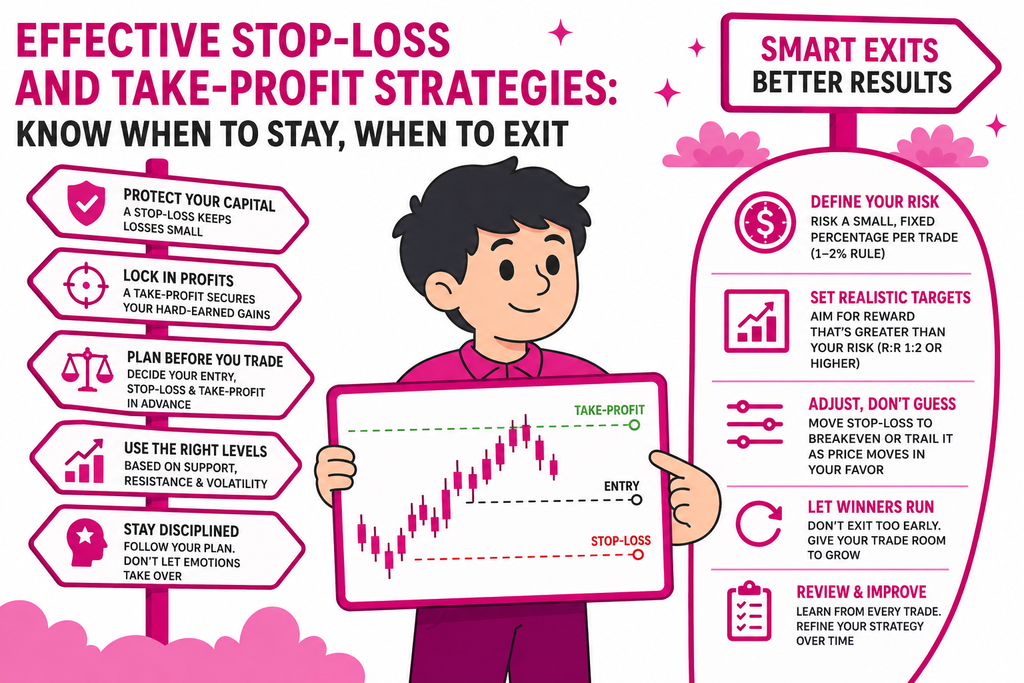
A Stop-Loss (SL) tells you where to get out when a trade goes against you, while a Take-Profit (TP) tells you where to secure your gains when the market reaches your target.
They are not signs that you expect your trade to fail. They are signs that you have a plan.
Stop-Loss: Your Trading Seatbelt
A stop-loss is like a seatbelt in a car. You hope you never need it, but you should always have it.
Suppose you buy EUR/USD at 1.1700 because you expect the price to rise. You identify 1.1660 as an important support level.
Instead of saying, “I will close the trade if it looks bad,” you could place your stop-loss below the level, for example at 1.1655. If the market falls and reaches your SL, the trade closes automatically.
You don’t have to panic, freeze or keep saying: “Let me give it just a little more room.”
That “little more room” can sometimes turn a small loss into a big one.
Take-Profit: Know Where to Collect
Take-profit works in the opposite direction.
Imagine you buy Gold at $4,600 after identifying support and bullish momentum. Your analysis shows the next major resistance around $4,660.
You could set:
Entry: $4,600
Stop-Loss: $4,570
Take-Profit: $4,660
If Gold reaches $4,660, the position can close automatically and lock in your profit.
This prevents another common trading mistake:
Watching a profitable trade become a losing trade because you refused to take profit.
Think in Risk-to-Reward
One of the most important concepts when setting SL and TP is Risk-to-Reward Ratio (RR).
Suppose you risk $100 to potentially make $200.
Your risk-to-reward ratio is: 1:2 You are risking $1 to potentially make $2.
For example: Risk: 50 pips Target: 100 pips RR: 1:2
The goal isn’t to win every trade. The goal is to ensure that your potential reward is sensible compared with what you are risking.
Don’t Place Your Stop-Loss Randomly
A common mistake is choosing an SL simply because it “looks comfortable.”
For example, you buy because the price breaks above resistance and then place your stop-loss only 5 pips below the entry.
The market makes a normal pullback, hits your SL, and then continues upward.
You might think: “The broker hunted my stop!”
Sometimes the problem isn’t the market. Your stop may simply have been too close to normal market volatility.
A better approach is to consider:
- Previous swing highs and lows
- Support and resistance
- Market structure
- Trendlines
- Volatility, such as ATR
- The size of the trading setup
Your stop should be placed where your trade idea becomes invalid, not simply where the loss feels comfortable.
Use Market Structure to Set Your Targets
Take-profit levels should also have a reason behind them.
Imagine BTC/USD is making higher highs and higher lows. You enter after a pullback from support.
Instead of randomly choosing a $500 target, look for the next important resistance or previous swing high.
Your setup could be:
Entry → $65,000
SL → $64,500
TP → $66,000
Here you are risking $500 for a potential $1,000 gain.
That’s a 1:2 RR setup.
The market decides whether the target is reached. Your job is to define the plan before entering.
Consider Trailing Stop-Losses
What if your trade moves strongly in your favour?
A trailing stop can help protect part of your unrealised profit while allowing the trade room to continue.
For example, you buy Gold at $4,600 and price rises to $4,650.
Instead of leaving your original SL untouched, you could move it higher according to your trading plan.
If Gold continues to $4,700, you may capture more of the move.
If it reverses, the trailing stop can help protect some of the gains.
Think of it like walking up a mountain while moving your safety rope higher behind you.
Position Size Comes Before the Stop-Loss
Here’s a critical point:
Don’t choose your lot size first and then force your stop-loss to fit it.
Instead:
Decide your risk → identify your logical SL → calculate your position size.
For example, if your trading plan allows you to risk $100, your stop-loss distance and instrument determine the appropriate position size.
This helps prevent a common mistake:
“I want to trade 1 lot, so I’ll make the stop-loss very tight.”
Your lot size should serve your risk plan—not the other way around.
Don’t Move Your Stop Because You’re Emotional
The market moves against you.
You see your trade approaching its stop-loss.
Suddenly you think:
“I’ll move the SL lower. It will come back.”
This is where a planned trade can become an emotional trade.
If your original analysis is invalidated, accepting the loss may be the correct decision.
Remember:
A small controlled loss is part of trading. An uncontrolled loss can damage your account.
A Simple SL & TP Checklist
Before entering a trade, ask yourself:
1. Where is my entry?
2. Where does my trade idea become invalid?
3. Where is the logical stop-loss?
4. Where is the next realistic target?
5. What is my risk-to-reward ratio?
6. What position size matches my risk?
7. Am I placing the trade based on a plan or emotion?
If you cannot answer these questions, you may not be ready to enter the trade.
Final Thought
Stop-loss and take-profit orders are more than trading-platform buttons.
They are tools for discipline.
A good trader doesn’t enter the market thinking only about how much they can make. They also ask:
“How much am I willing to lose if I’m wrong?”
And:
“Where will I take my profit if I’m right?”
The market will always surprise you.
Your advantage is not knowing exactly what will happen next.
Your advantage is knowing what you will do when it happens.